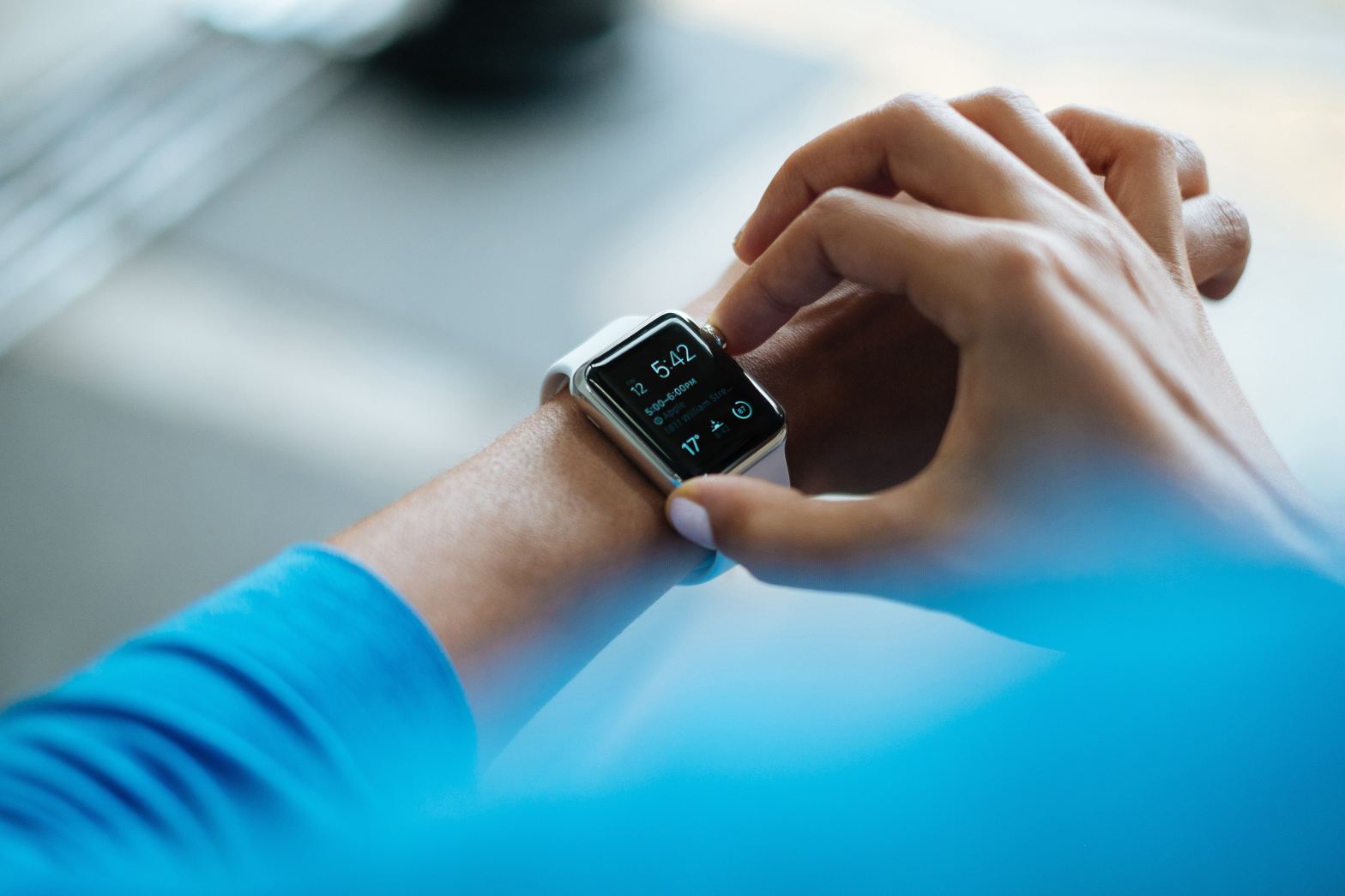
Photo by Luke Chesser on Unsplash
Victoria Sanseverino
Encompassing a variety of brands and mediums from apps to smartwatches and beyond, the demand for wearable health technology products shows no signs of slowing down.
There were just under 44,400 iOS healthcare apps available for download in Q3 2019, according to Appfigures. This number does not include health and fitness apps, such as MyFitnessPal and Headspace, of which there were 320,000 available for download in 2018 from major app stores, according to Global News.
According to a 2018 report compiled by the Consumer Technology Association, smartwatches are very close to becoming a mass market commodity, even though industry observers about three years earlier had dismissed these products as being a passing fad.
But wearable health technology has been around for much longer than we realize. According to Iona College Sociology professor Marcus Aldredge, Ph.D., wearable health tech has just taken on a new form.
“…if we go backwards, we will find it [wearable health technology] 200 years ago when Ben Franklin was making false teeth,” says Dr. Aldredge. “Any sort of technology that we use that we start to then integrate into our bodily behavior starts to begin the process of an amalgam of physical body and technology.”
Global smartwatch shipments grew 56 percent from the previous year, reaching a record of 18 million units in Q4 2018, according to Strategy Analytics, an independent research and consulting firm.
Apple Inc., Fitbit Inc. and Samsung jointly dominate the U.S. smartwatch market, according to the Consumer Technology Association. The three brands have a combined market share of over 75 percent, according to Parks Associates.
By the end of 2018, Apple controlled 50 percent of the global smartwatch market based on number of units shipped, according to CNBC and SA. Fitbit came in at just over 12 percent, while Samsung came in third at just under 12 percent.
Released by Apple in 2015, the Apple Watch has quickly become the best-selling wearable device, with the tech company already on its sixth version of the product as of September 2019, Apple Watch Series 5.
SA reveals that Apple shipped approximately 9 million smartwatches worldwide during Q4 2018, an 18 percent increase from almost 8 million units in 2017.
Compatible with the iPhone and a number of health apps, including the Apple Health app, the Apple Watch has a wide range of features which, according to the company’s website, “inspires a healthier life.”
The newest iteration of the Apple wearable has a built-in electrocardiogram which can send notifications to the wearer if their heart rhythm shows signs of atrial fibrillation—an irregular heart rhythm.
The Apple Watch Series 5 allows for users to share ECG results with their doctor in a condensed report, which includes the user’s ECG waveform, its associated classifications and any symptoms, according to the company’s site.

Fitbit was previously first in health tracking enabled smartwatch sales until the emergence of the Apple Watch, according to the Consumer Technology Association. To catch up with the trajectory of the wearables market, FitBit is updating its products.
In September 2019, Fitbit released the second iteration of its Versa smartwatch, which bears a striking resemblance to the Apple Watch with its rounded square touch face.
Compatible with a wide variety of mobile devices and apps, the Versa 2 has a variety of features, including 24-hour heart rate tracking, sleep tracking and Amazon Alexa built-in for voice requests, according to the company’s site.
Fitbit has demonstrated that it has the capacity for growth, shipping 2.3 million units in Q4 2018; a considerable increase from Q4 2017 when the brand shipped only 0.5 million units, according to SA.

Additionally, Google LLC announced in November 2019 their planned acquisition of Fitbit for just over $2 billion, meaning a possible market comeback may be somewhere in the brand’s future.
But do these health tech wearables actually make us healthier? “It’s a good question,” says founder and CEO of MediSprout, Samant Virk M.D.
“It’s a good question because the data shows there’s a huge drop-off rate, I think three months is the time, where…people track themselves up until a certain point and then they essentially drop off,” says Dr. Virk. “And the other part of it that is a little discouraging is that the people who end up tracking it are healthy anyway.”
But these devices do have great potential to actually drive long term change in healthcare if used in conjunction with a user’s clinician or their physician, says Dr. Virk.
His company is currently working on integrating the capability of wearables with his platform.
“…if you have those devices [Fitbit, etc.] at home, when you are on a virtual call with your doctor, you can push a button and share that information with them,” says Dr. Virk. “…now that information is a team concept between you, your doctor and the device; we bring all three of those things together to actually create utility.”

 Data Journalism 395