By: Duncan Wallace
Date: Dec. 13, 2021
With the ongoing trial of accused child sex trafficker Ghislaine Maxwell, formerly the girlfriend of convicted sex offender Jeffrey Epstein, modern slavery, or similarly known as human trafficking, is a hot topic. Human Trafficking involves the transfer of people through “force, fraud, or coercion to obtain some type of labor or commercial sex act,” according to Homeland Securities Blue Campaign.
While attention is on the subject, it’s important to make known the prevalence of the issue, especially for the future of the United States and the World. Victims and convicted traffickers are key figure points in this research that are compared to discover any disproportionalities.
The threat of trafficking is present worldwide, and has been increasing through the years, as seen in data from the United Nations Office on Drugs and Crime, or UNODC.
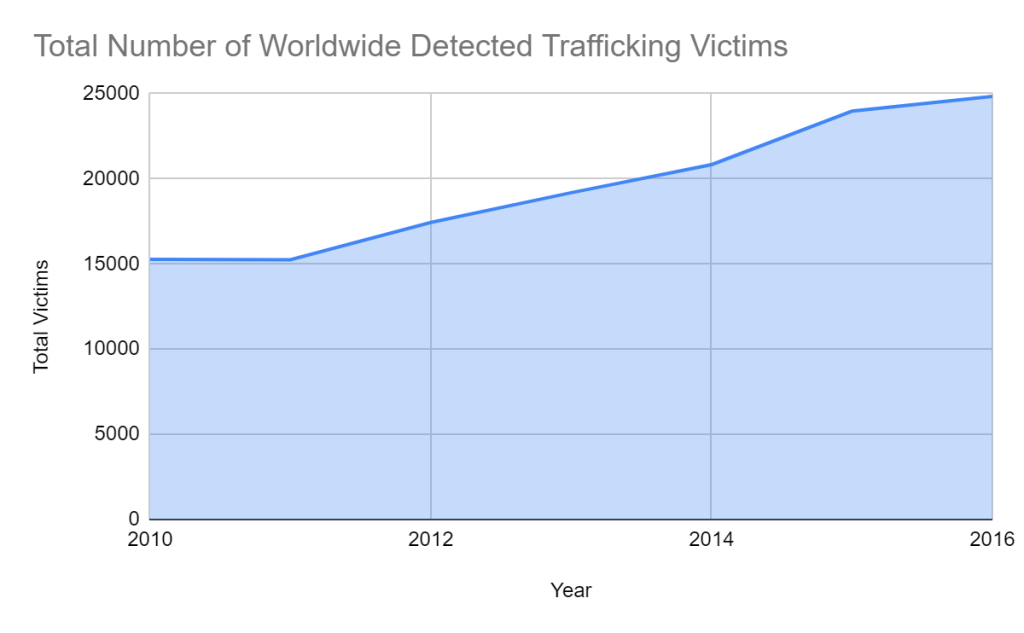
| Year | 2010 | 2011 | 2012 | 2013 | 2014 | 2015 | 2016 |
| Total Victims | 15,269 | 15,254 | 17,444 | 19,185 | 20,836 | 23,974 | 24,843 |
| Amount of Countries Covered | 89 | 80 | 92 | 87 | 107 | 103 | 102 |
The data gathered originates from national authorities answers on the annual United Nations Crime Trend Survey. It’s also considered that the amount of countries covered in this analysis doesn’t remain consistent throughout the years, which may be a factor in the results.
In the data, we see a 62.7% increase in victims when comparing the years of 2010 to the most recently available 2016. The comparison is significant, though when comparing 2015 to 2016, an increase of 3.6% is seen. A gradual increase in victims over the years is confirmed regardless of it’s rate of increase.
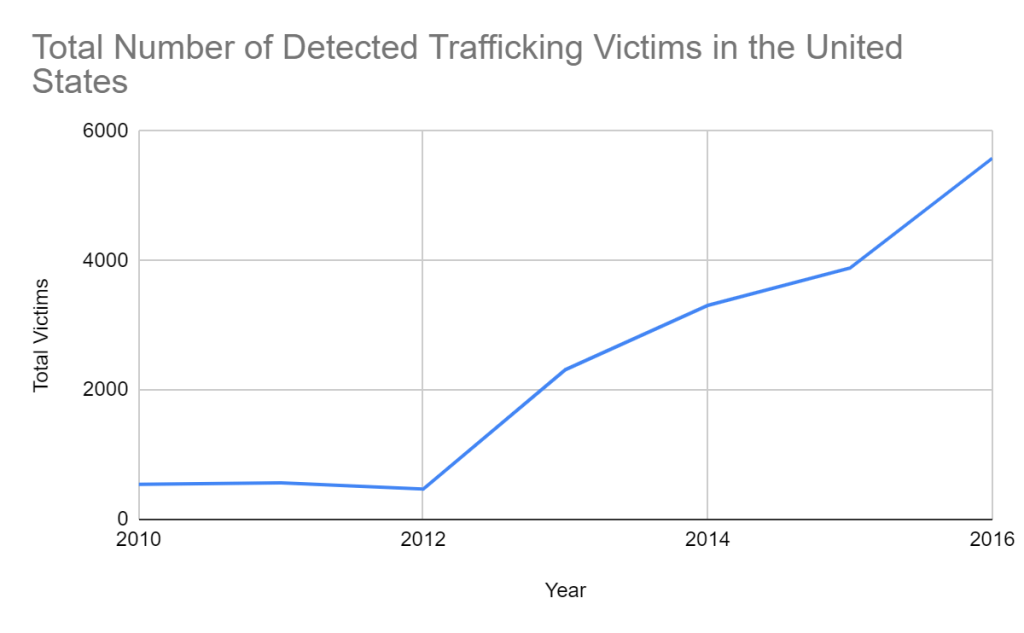
| Year | 2010 | 2011 | 2012 | 2013 | 2014 | 2015 | 2016 |
| Total Victims | 541 | 564 | 469 | 2315 | 3308 | 3885 | 5582 |
The data gathered shows the U.S. had a significant increase of 393.6% in total victims between the years of 2012 and 2013. When comparing 2012 to 2016, a noteworthy increase of 1090% is seen through the data. Another large jump can be seen in comparing 2015 to 2016, with a 43.7% increase.
In 2016, the data shows that the United States total victims make up a significant 22.5% of global victims. Assuming that the number of victims continues to gradually or significantly increase, the U.S. will continue to have, and possibly have more problems with trafficking.
When analyzing the amount of convictions for trafficking, both worldwide and in the U.S., to the amount of victims, a disproportionality can be seen according to data from the UNODC.
| Year | 2010 | 2011 | 2012 | 2013 | 2014 | 2015 | 2016 |
| Number of Convictions | 141 | 151 | 138 | 174 | 184 | 297 | 297 |
| Year | 2010 | 2011 | 2012 | 2013 | 2014 | 2015 | 2016 |
| Number of Convictions | 4084 | 5079 | 7846 | 7018 | 6102 | 5707 | 3382 |
This data was collected through questionnaires given to national authorities, and similar to the data on victims. The countries in which data is collected from aren’t completely consistent through every year.
Data from the United States shows a generally positive trend in the increasing number of convictions between the years of 2010 to 2015. In 2016, no rate of change can be seen, potentially suggesting a plateau in convictions with a continually increasing number of victims.
Worldwide, we see 2012 showing the highest number of convictions, maxing out at 7,846 people. When comparing that to 2016, a decrease of 56.9% is seen. The data shows 2016 as the lowest point in convictions, which can be attributed to less people getting caught.
There appears to be a disproportionate number of victims when compared to actual convictions. With this being said, that can possibly be explained by the number of victims per convicted, though not enough data is available to completely confirm that.
With increasing numbers of victims, methods to keep oneself safe are expected, examples including the National Human Trafficking Hotline. This hotline is able to receive tips on potential trafficking situations, as well as support victims of trafficking.
The increase in victims over time within the United States coincides with an increase in the number of reports or tips, according to data from the National Human Trafficking Hotline.
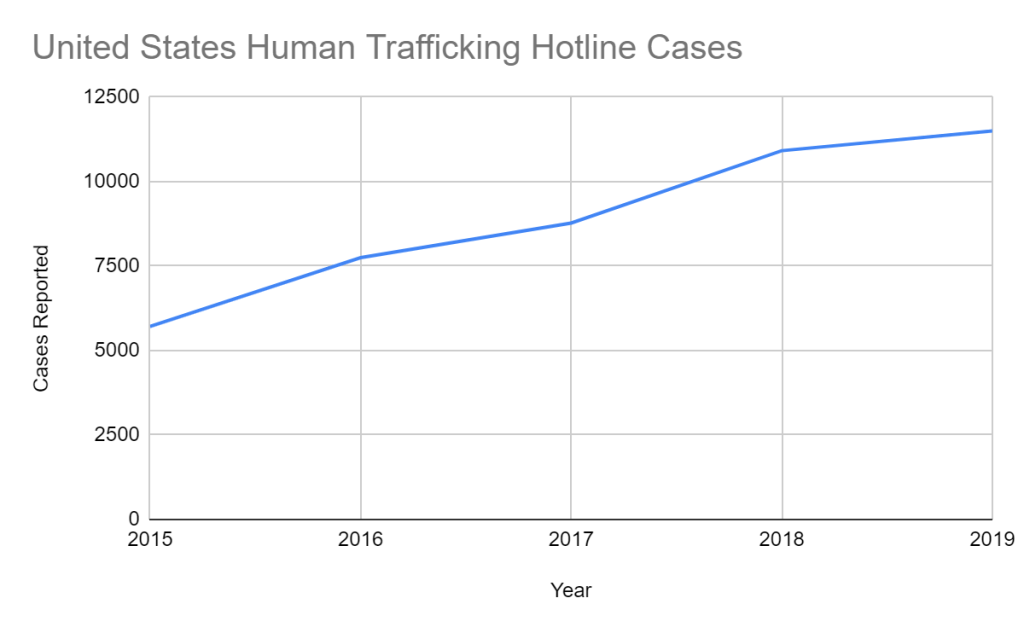
| Year | 2015 | 2016 | 2017 | 2018 | 2019 |
| Cases Reported | 5,714 | 7,748 | 8,773 | 10,915 | 11,500 |
Within the years of 2015 and 2016, a 35.6% increase in cases reported can be seen. When comparing trafficking convictions in the U.S., as well as U.S. victims of trafficking within the years of 2015 to 2016, the disproportionality of arrests becomes clear with significantly increasing numbers over time in all cases except convictions.
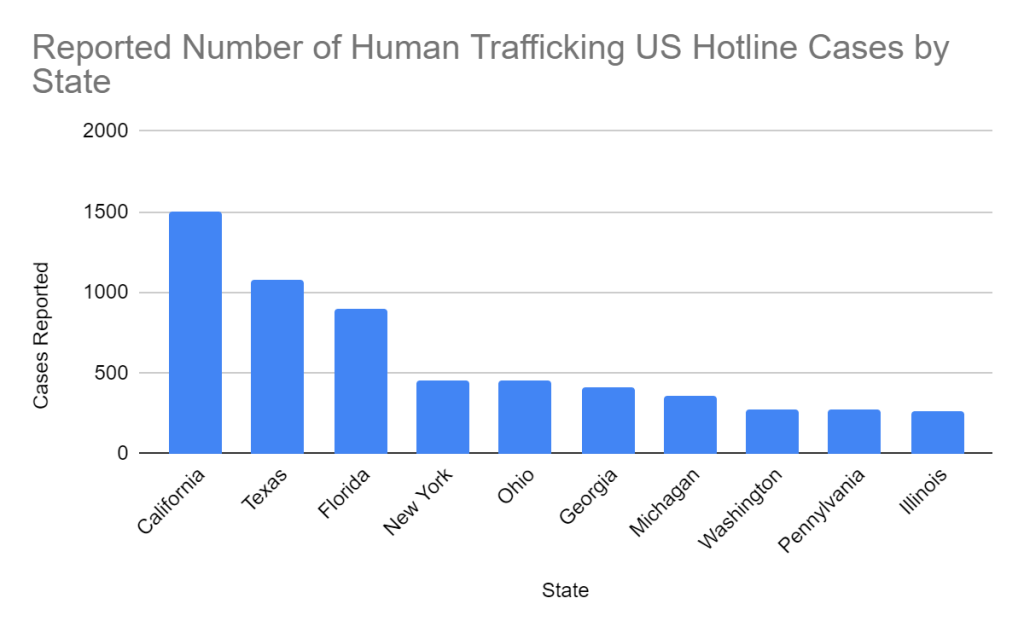
| State | California | Texas | Florida | New York | Ohio | Georgia | Michigan | Washington | Pennsylvania | Illinois |
| Cases Reported | 1,507 | 1080 | 896 | 454 | 450 | 417 | 364 | 272 | 271 | 267 |
According to the National Human Trafficking Hotline, currently California places at the top of all states in terms of how many cases of human trafficking were reported. Understanding where, and what makes someone more at risk of trafficking than another allows a person and others to be able to protect themselves and understand what signs to look out for.
According to the hotline’s 2019 Data Report, a majority of about 68% of victims tend to be female. The most common areas in which the hotline finds victims of trafficking, be it labor focused or sex work focused, are in “illicit massage, health, and beauty” at most, “illicit activities” in second, and “bars, strip clubs, and cantinas” in third.
Additionally, recruitment tactics of sex trafficking specifically consist of using primarily a relationship/marriage propositions, as well as using family, job offers, and fraud. Labor trafficking consists of primarily job offers and advertisements, as well as fraud.
To conclude, the issue of human trafficking has been significantly increasing through the years, while the number of those who get convicted for trafficking are inconsistently decreasing or plateauing. If the patterns in the data continue as they have been, the problem will only get worse, causing more victims overall. The United States may not be the highest country in the world in terms of trafficking danger, but without increases in arrests and convictions, the problem will persist and terrorize citizens in terms of increasing victims as well as increasing fear over the subject.
Sources:
Global:
https://dataunodc.un.org/data/TIP/Detected%20trafficking%20victims
https://dataunodc.un.org/data/TIP/Detected%20trafficking%20victims
U.S.:

 Data Journalism 395