Spirituality and Religion Uprising

Spirituality and non-traditional religions are uprising more today than ever

            Many people are aware of and believe in a well-known concept of astrology, where the stars and planets’ positions during the time of your birth determine many different factors about your personality and your traits. With the increased interest in astrology for the past couple years, people are left wanting to learn more about themselves as well as the people around them. Callie Beusman, a senior editor at Broadly, says traffic for the site’s horoscopes “has grown really exponentially”. However, astrology is just a small part in looking at the bigger picture of new age beliefs. New age beliefs about religion and spirituality include categories such as astrology, reincarnation, supernatural phenomena, spiritual energies, and much more. But the real question is, how did we get here? When did the focus from traditional religions shift into the meshing of religions put into one, and start to include these new aspects considered to be related to religion?

            Spirituality is defined by Mateo Sol over at lonerwolf.com as “connecting to the Divine through your own personal experience. It is primarily concerned with finding, experiencing, and embodying one’s true spiritual nature”. However, for those that do consider themselves to be spiritual, there are an abundance of different definitions that can explain what spirituality means to that particular person. Wikipedia explains spirituality to be “the quality of being concerned with the human spirit or soul as opposed to material or physical things”. Through these two definitions we can make the assumption that spirituality has to do with one’s ability to connect with the world through a different process than a traditional religion. For example, many people who consider themselves to be spiritual but not religious (27% of adults consider themselves to be spiritual but not religious, according to a Pew Research Center poll.) may not follow the traditions of religions, such as going to church, praying, fasting during certain periods of the year, etc. However, many people (48% of adults according to the same PRC poll) consider themselves to be both spiritual and religious, which seems to be more popular. This could mean many things, such as they are aware of their spirit and the impact it has on the world, while also believing in God, for example, and continuing to go to church, and believing that once one’s life comes to an end on this Earth, that they either go to heaven or hell. Additionally, in a survey released by Vice in 2018, 80% of millennials and generation Z interview said they had a sense of spirituality and believe in some sort of cosmic power. “Over the past two years, we’ve really seen a reframing of New Age practices, very much geared toward a Millennial and young Gen X quotient,” says Lucie Greene, the worldwide director of J. Walter Thompson’s innovation group. 

            So why is it that less people are becoming spiritual? According to an article from Pacific Standard, Generation Z is the least religious generation. However, millennials are also in on the decline of traditional religions. According to a Pew Research Center Poll collected in 2015, 35% of adult Millennials (Americans born between 1981 and 1996) are religiously unaffiliated as a whole. Many people, specifically Millennials and Generation Z, do not considers themselves part of a religion for many different reasons. One reason is that through the use of social media and the internet, organized religions are sometimes viewed as intolerable and abusive- take an example to be the treatment of women within some Muslim communities. Another reason for this is the whole topic of this article- that many people in these generations create their own spirituality from a combining of different religions- such as yoga, astrology, angels, etc. I interviewed my roommate Nina Purut, 21, who is Armenian and grew up in an Apostolic Christian household and she said that “A lot of people start to become spiritual because of astrology and want to learn about themselves and other people- but they want to use that as a way of knowing everything about everyone. Spirituality to me is knowing who I am and why I was put on this Earth by God, but also knowing the effects of the people and things around me”. 

            Even though religion can be a very touchy subject to all generations, it is a conversation that should be had regardless to beliefs. Those who follow a spiritual way of thinking and being, specifically generation z and millennials, are continuing to increase and become more popular. This is definitely the generation for figuring out their lives and their beliefs on their own. 

Nia Sago

MCO 395
Streaming Services continue to take over the Music Industry, while their Data helps Musicians in new and detailed ways

By James Corrigan

New York, NY – It’s no secret that streaming services have become the new most popular way for Americans and much of the rest of the world, to absorb entertainment, especially music.

There has been an immense increase of the use of streaming in the United States for accessing music within the last 5-6 years. The number of audio and video music streams has surged by 800%, reaching over 900 billion streams in 2019 compared to a total of only about 106 billion in 2013, according to Neilson data.

It’s due to the speed and convenience factor, as the nature of streaming services is to have massive libraries of instant access content, which can be accessed wherever there is Internet connection. In addition to this, most are available on almost any device platform (phones, computers, laptops, smart TV, tablets, etc.).

Not only is streaming becoming more popular, but also other forms of music product consumption are continuing to lose traction in the share of revenue that they account for yearly.

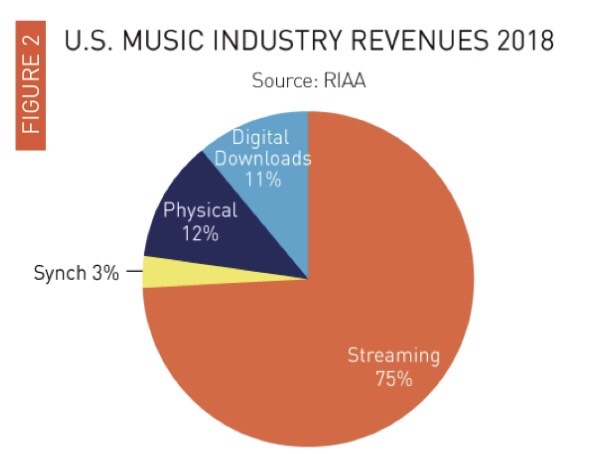
According to a chart published by the Recording Industry Association of America or RIAA, paid subscriptions alone accounted for $5.4 of the $9.8 billion of total revenue in 2018. This is up another 32% from 2017; while physical copies and digital permanent downloads each took an overall decrease of over $300 million in revenue from 2017 to 2018.

Via. RIAA 2018 Year end Report

Physical copies and permanent digital downloads only a decade ago were the main source of revenue for the industry, but in 2018 they combined to account for less than 25% of total revenue. In an interview with The Rolling Stone magazine, famed guitarist and songwriter of the White Stripes, Jack White said this,

“I definitely believe the next decade is going to be streaming plus vinyl. Streaming in the car and kitchen, vinyl in the living room and the den. Those will be the two formats. And I feel really good about that.”

White’s predictions are so far not wrong, as the RIAA report also showed that vinyl was the only form of physical sale that boasted an increase in revenue share from 2017-2018.

These new data sets that are a result of the immense growth in popularity of streaming are creating opportunities for musicians that have never before been available. Spotify’s CEO, Daniel Ek, said this to The Rolling Stone in a 2018 interview regarding what this immense amount of new streaming data means for artists in the music business,

“We’ve never before been at a place in time where you could make as many informed decisions and understand your audience as well as we can do now as an artist,”

Each individual stream holds its own set of data, which can be analyzed with new tools like Spotify for Artists. This allows them to look at a number of different things occurring when a user listens to a song. The artist can look at how many people have streamed and listened to the song, how many people have saved it to their library, and the average amount of time that a listener will stay on the song for. This could allow artists to figure out what part of a song might be holding it back from becoming successful, or what part of a song is especially popular among listeners.

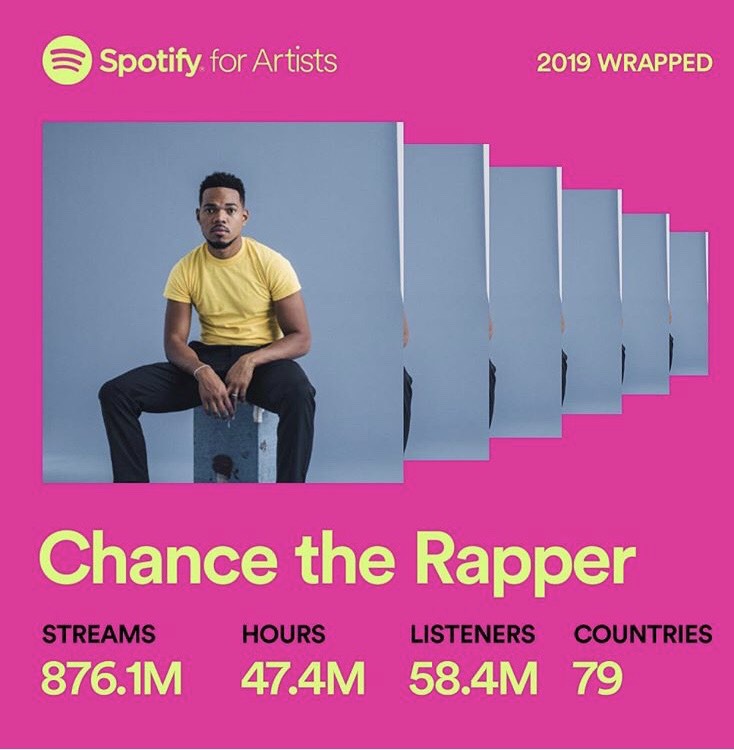
Chance the Rapper’s Spotify Data for 2019

The new technology also offers opportunities to make geographically strategic decisions. An artist could determine which of their songs is more popular in a certain area and select a set list for a show in that area based on the streaming data.

I interviewed a band from my home town to see how smaller artists are using this new technology and data to their advantage as well. The band, Blac Rabbit, is a psychedelic rock group from Queens, NY, whose main members are two brothers Raheim and Amiri Taylor. They went viral a few years ago covering Beatles songs on the NYC subway and have used that as a springboard for success, now playing small venues, making original music and publishing it on Spotify and Apple Music.

“Streaming services and the connectedness of social media, allows smaller artists like us to be seen and heard by people that would have been impossible to reach only just a decade or so ago. And at the same time we also get the same level of detailed information and feedback on our published music that artists that have a larger fan base do.”

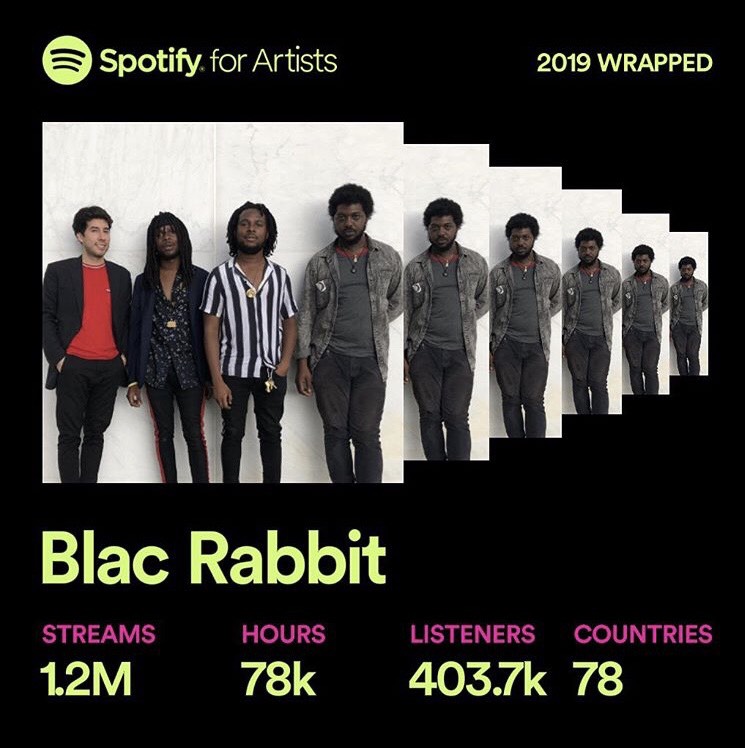
Blac Rabbit’s 2019 Spotify year end data

Small artists are using it to get their first glimpse of popularity and success, and older artists are using it to gain new ear exposure on their old music. New apps are being developed constantly to keep up with competition as the value of this new streaming data is becoming recognized. All while the new subscription based platform continues to dominate the industry, and change its very structure.

United States’ cities that receive the most live entertainment

https://www.vividseats.com/blog/top-live-music-cities-infographic

The roar of the crowd, the beat of the drums, the shining lights and the intensity are all aspects of a concert. The crowd’s favorite musician takes their place on stage. The songs they spent countless hours memorizing have finally come to life. Lights, voices and high energies are flooding the arena. The worldwide phenomenon has finally made a tour stop to the small, unknown city.

Concerts and live music have been a popular form of entertainment ever since music was essentially created. Fans and supporters love to enjoy the popular tunes of their favorite artist or band in a crowded concert hall or venue. The United States is home to numerous city sights that have venues to host these concerts. Although, some cities get more attraction than others.

It is essentially up to the band or artist as to where they are going to hold shows. Cities with higher rates of tourist attraction tend to more commonly be on the list for these concert dates. TBA, a blog run by Seat Geek explains which cities receive the most live entertainment.

“Las Vegas, NV is, by far, the biggest per capita market in the U.S., with 59 concerts per 100k residents…” Seat Geek said.  “…nearly 4 times the next market (Nashville, TN; 15.4).”.

With venues such as Caesar’s Palace and Planet Hollywood, Las Vegas is a major attraction for live entertainment.

Some other notable cities that hold the most concerts per year are Nashville, Tennessee, New York City, New York, Austin, Texas, Los Angeles, California and many more, according to Seat Geek. The popularity of concerts in these cities all depend on the demographics, age groups, genre of music and availability of venues.

Other cities are not so fortunate to have live performances are Springfield, Missouri, Savannah, Georgia, Providence, Rhode Island and Baton Rouge, Louisiana. Each city has been reported to have less than 5 concerts a year per 100,000 residents, according to Seat Geek.

Harper Beattie, an employee of the music-based marketing company, Superfly, states “Artists tend to work together with ticket vendors to select cities based on their levels of attraction and fan interaction.”.

Another factor that contributes to the number of concerts each city has is the genre of the music being played. Research done by Fandemonium, a blog run by ticket selling platform, Vivid Seats, showed that northeastern regions of the United States tend to host more rock concerts than the southern region, which hosts more country and folk concerts.

Philadelphia, Pennsylvania and Boston, Massachusetts hold some of the most adult alternative concerts not just in the northeastern region, but in the United States as well, according to Vivid Seats. Austin and Dallas Texas, along with major cities in the south hold more country and folk concerts. With Nashville, Tennessee as the home of country music, it is explainable as to why the southern region flocks more toward this genre.

Although, according to Seat Geek’s report, rock music does hold the most concerts per 100,000 people, but country music is not far behind and is slowly catching up. Rock music holds 2.3 concerts per 100,000 people while country holds 1.7, with pop, rap/hip-hop and R&B lower on the list.

Another factor that contributes to the number of concerts per city is the age of these concert attendees. Culture Trip claims that college towns like Athens, Georgia, Boulder, Colorado, State College Pennsylvania and other major university cities, tend to receive more performances due to the larger student bodies.

Many of these concerts are free or even have tickets sold at a lower price to appeal more to students. According to the website, Best Colleges, Schools like Pennsylvania State University, Yale University and University of Southern California often book major headliners for their students to enjoy.

The United States hosts many different forms of live entertainment, some cities more than others. The factors that determine the number of concerts that each city receives are very widespread. Seat Geek says that many up and coming cities would be able to gain more concerts, as well as other genres in different regions

Where Disney+ Falls in the Streaming Wars: By the Numbers

Streaming services have been on a rapid rise in the past decade, and the newest player in the already crowded competition is Disney+. 

The Mouse House’s new service debuted Tuesday, November 12, and hit 10 million subscribers within its first 24 hours, according to a report by the research firm Apptopia. Fox Business elaborated on the Apptopia report, stating that within its first week, Disney+ racked in over 25.6 million daily viewing sessions and, during the last week of November, the streaming service broke 15 million downloads.

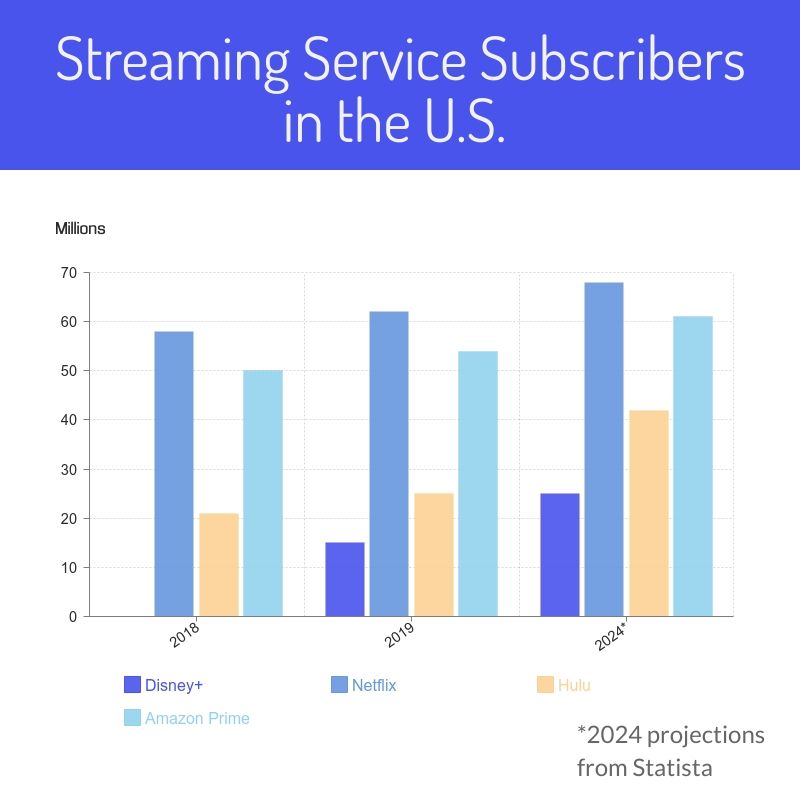
The road ahead looks rosy for the new streaming service, a survey suggests, Disney+ is projected to reach almost 25 million domestic subscribers by 2024, a survey conducted by Digital TV Research and published on Statista this past October reports. However, the unanticipated popularity of the streaming service could drive those numbers higher in the coming months considering that just last week, Apptopia reported that Disney+ has surpassed 22 million mobile device downloads. Google Trends also announced earlier this month that “Disney Plus” was Google’s most searched term of 2019.

Lead Chairman for Disney+, Kevin Mayer, told The Hollywood Reporter earlier this year that the company is aiming to reach between 60 and 90 million within the next five years. 

We like the hand we have… We’ve collected some of the most preeminent brands in the entertainment sphere and we’re using them aggressively. We have the timing. We have the right price point.

Kevin Mayer, Disney+ Lead Chairman

Netflix, one of its main competitors, currently has about 60 million subscribers in the US. Amazon Prime has around 50 million subscribers, and Hulu trails behind with about 25 million, according to the Statista report.

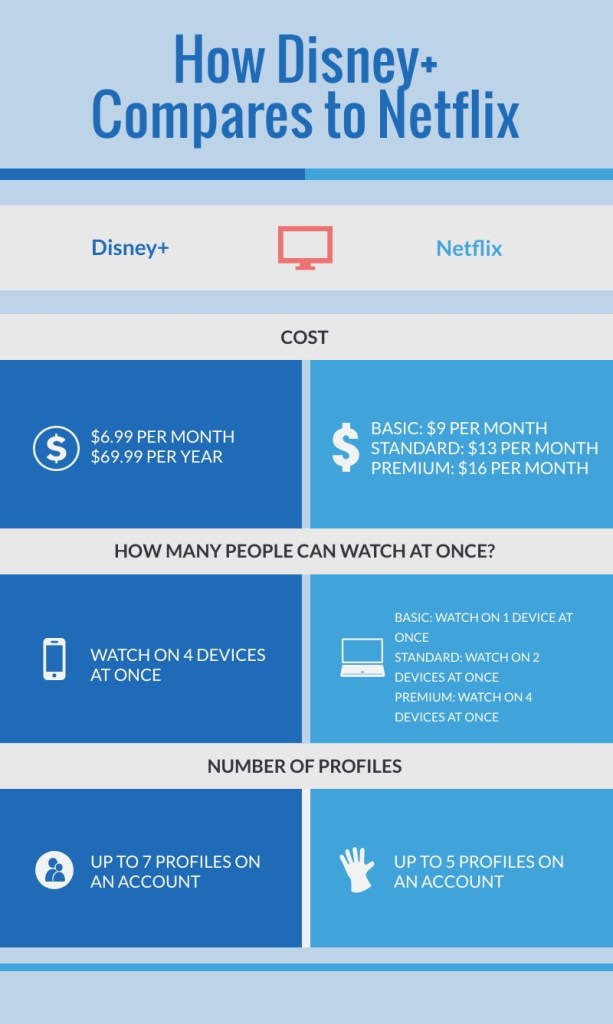
Disney+ is noticeably less expensive than Netflix and Hulu, costing $6.99 a month compared to $9 for the basic Netflix plan, $5.99 for the basic Hulu plan with “limited commercials,” and $11.99 for Hulu’s ad-free version. Hulu, however, hopped on the Disney bandwagon: Disney+ is offering a package deal with Hulu and ESPN+ for $12.99 a month. Disney+ also allows for up to four users to stream at the same time, a feature included with the premium Netflix subscription for $15.99 a month. 

Within its first year, Disney+ is slated to have 7,500 television episodes and 500 films. By 2024, the company projects the streaming service to “encompass over 120 recent movie releases and more than 500 library films; over 10,000 TV episodes; and more than 50 original series and 10 original films and specials.” Franchises within Disney+ include Pixar, Marvel, Star Wars, and National Geographic, each with their own original films, series, and specials.

Disney has invested billions of dollars into the streaming service, which has accumulated over $5 million through in-app purchases of subscriptions within its first 13 days, according to the data from Apptopia. 

Last month, Netflix announced a partnership with Nickelodeon to parallel Disney+ and its Disney Channel content. However, according to Apptopia Vice President Adam Blacker, “Netflix, Amazon Prime Video and HBO Now have not been moved off their trend lines in the U.S,” but, ”…as Disney+ grows in users and markets, that could change.”

Blacker also praised the combination of Disney’s promotion to give all of Verizon’s millions of customers free one-year subscriptions to Disney+ and the service’s general affordability: “Just look at the box office numbers for the Marvel movies and the new Star Wars movies… The amazing price point, which will absolutely be increased at some point, combined with the ability for many people to get the service free through a deal with Verizon is a recipe for mass adoption.”

In a poll taken by Credit Suisse, 34% of Verizon customer-service representatives said they believe that “the free Disney+ offer drove customers to upgrade to unlimited service,” to be eligible for the promotion. 

But just because people are flocking towards Disney+, it does not necessarily mean they will flock away from the other major streaming services. Two Wall Street analysts surveyed Netflix subscribers and found that people are most likely to just subscribe to several streaming services. Their study found that, “while interest in Disney+ has increased… we have not seen an increase in the percentage of Netflix subscribers who expect to cancel Netflix in favor of Disney+.”

Wearable Health Tech Popularity Continues to Soar

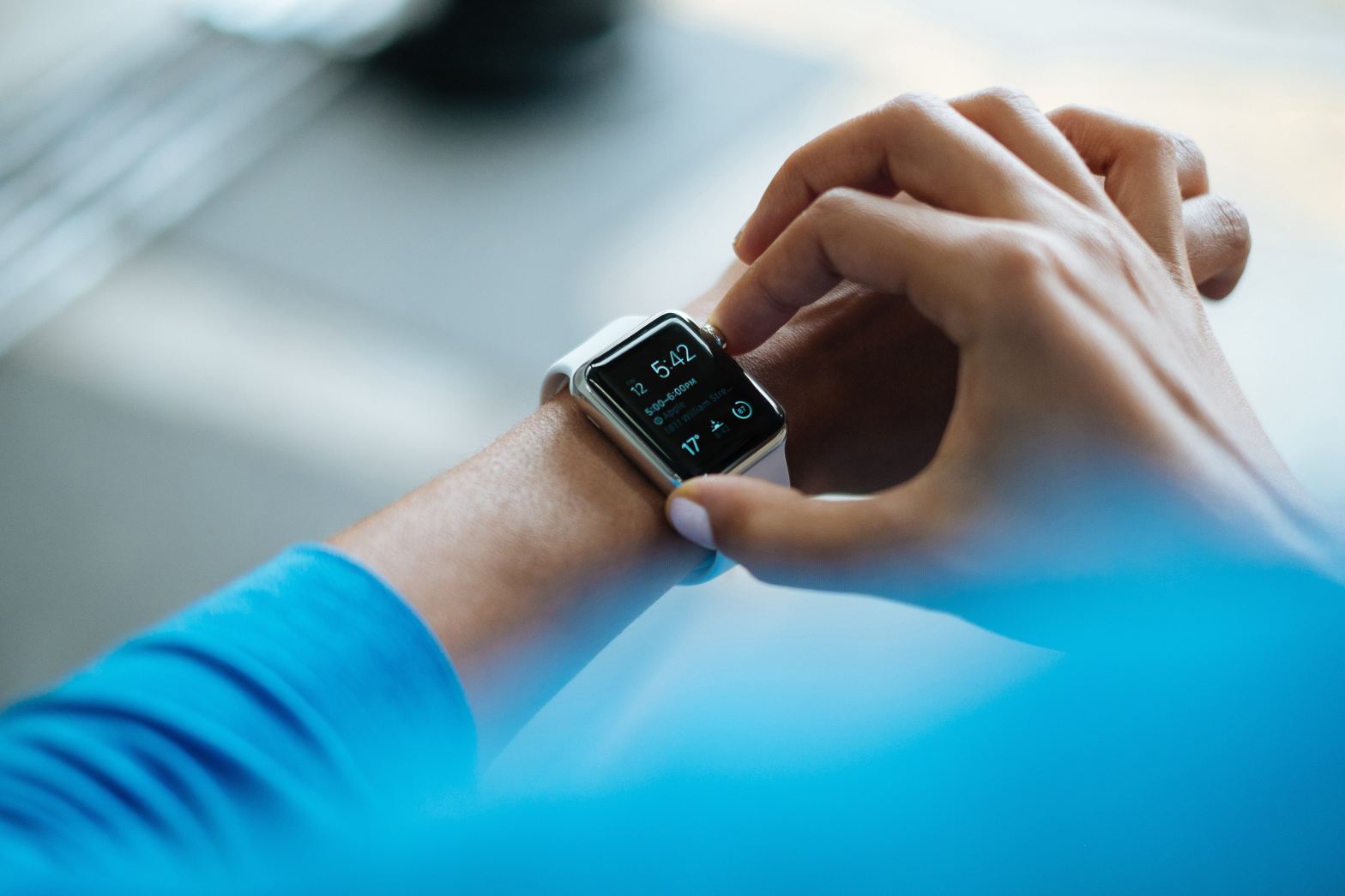
Photo by Luke Chesser on Unsplash

Victoria Sanseverino

Encompassing a variety of brands and mediums from apps to smartwatches and beyond, the demand for wearable health technology products shows no signs of slowing down. 

There were just under 44,400 iOS healthcare apps available for download in Q3 2019, according to Appfigures. This number does not include health and fitness apps, such as MyFitnessPal and Headspace, of which there were 320,000 available for download in 2018 from major app stores, according to Global News. 

According to a 2018 report compiled by the Consumer Technology Association, smartwatches are very close to becoming a mass market commodity, even though industry observers about three years earlier had dismissed these products as being a passing fad. 

But wearable health technology has been around for much longer than we realize. According to Iona College Sociology professor Marcus Aldredge, Ph.D., wearable health tech has just taken on a new form.  

“…if we go backwards, we will find it [wearable health technology] 200 years ago when Ben Franklin was making false teeth,” says Dr. Aldredge. “Any sort of technology that we use that we start to then integrate into our bodily behavior starts to begin the process of an amalgam of physical body and technology.”

Global smartwatch shipments grew 56 percent from the previous year, reaching a record of 18 million units in Q4 2018, according to Strategy Analytics, an independent research and consulting firm.

Apple Inc., Fitbit Inc. and Samsung jointly dominate the U.S. smartwatch market, according to the Consumer Technology Association. The three brands have a combined market share of over 75 percent, according to Parks Associates. 

By the end of 2018, Apple controlled 50 percent of the global smartwatch market based on number of units shipped, according to CNBC and SA. Fitbit came in at just over 12 percent, while Samsung came in third at just under 12 percent.

Released by Apple in 2015, the Apple Watch has quickly become the best-selling wearable device, with the tech company already on its sixth version of the product as of September 2019, Apple Watch Series 5. 

SA reveals that Apple shipped approximately 9 million smartwatches worldwide during Q4 2018, an 18 percent increase from almost 8 million units in 2017. 

Compatible with the iPhone and a number of health apps, including the Apple Health app, the Apple Watch has a wide range of features which, according to the company’s website, “inspires a healthier life.” 

The newest iteration of the Apple wearable has a built-in electrocardiogram which can send notifications to the wearer if their heart rhythm shows signs of atrial fibrillation—an irregular heart rhythm. 

The Apple Watch Series 5 allows for users to share ECG results with their doctor in a condensed report, which includes the user’s ECG waveform, its associated classifications and any symptoms, according to the company’s site. 

Photo by Andres Urena on Unsplash

Fitbit was previously first in health tracking enabled smartwatch sales until the emergence of the Apple Watch, according to the Consumer Technology Association. To catch up with the trajectory of the wearables market, FitBit is updating its products. 

In September 2019, Fitbit released the second iteration of its Versa smartwatch, which bears a striking resemblance to the Apple Watch with its rounded square touch face. 

Compatible with a wide variety of mobile devices and apps, the Versa 2 has a variety of features, including 24-hour heart rate tracking, sleep tracking and Amazon Alexa built-in for voice requests, according to the company’s site.  

Fitbit has demonstrated that it has the capacity for growth, shipping 2.3 million units in Q4 2018; a considerable increase from Q4 2017 when the brand shipped only 0.5 million units, according to SA.

Data from Strategy Analytics

Additionally, Google LLC announced in November 2019 their planned acquisition of Fitbit for just over $2 billion, meaning a possible market comeback may be somewhere in the brand’s future. 

But do these health tech wearables actually make us healthier? “It’s a good question,” says founder and CEO of MediSprout, Samant Virk M.D. 

“It’s a good question because the data shows there’s a huge drop-off rate, I think three months is the time, where…people track themselves up until a certain point and then they essentially drop off,” says Dr. Virk. “And the other part of it that is a little discouraging is that the people who end up tracking it are healthy anyway.” 

But these devices do have great potential to actually drive long term change in healthcare if used in conjunction with a user’s clinician or their physician, says Dr. Virk.

His company is currently working on integrating the capability of wearables with his platform.  

“…if you have those devices [Fitbit, etc.] at home, when you are on a virtual call with your doctor, you can push a button and share that information with them,” says Dr. Virk. “…now that information is a team concept between you, your doctor and the device; we bring all three of those things together to actually create utility.” 

A Year in Review for the Movie Theater Industry

by Christa Ryan

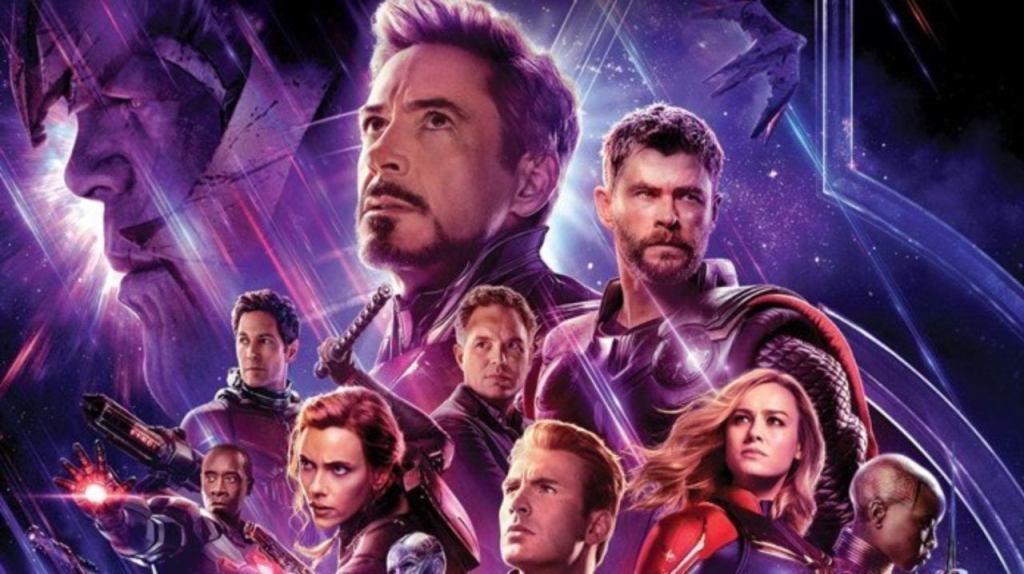
Going to the movies has been a favorite worldwide pastime for over 100 years. Due to continuous innovation in the movie industry, the landscape of movie-going has progressed, with the introduction of new technologies like three-dimensional theater experiences (3D movie experiences made up 16% of 2018’s global box office revenues). With today’s through-the-roof movie budgets—Marvel’s Avengers: Endgame, for example, was the most expensive film of 2019 with a budget of $356 million —it is interesting to take a look the way theatrical experiences play a part in the movie industry.

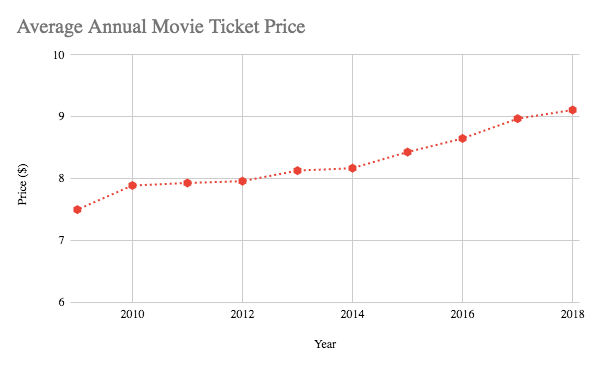
Thanks to steadily increasing theater ticket prices, with the average ticket costing American moviegoers $9.11 in 2018 due to inflation and the newfound popularity of three-dimensional movies and IMAX experiences, the United States box office has continued to see a rise in grosses. In 2018, the U.S. box office secured a total of $11.9 billion, up five percent from 2017 at a new high, according to the Motion Picture Association of America’s 2018 Theatrical and Home Entertainment Market Environment (THEME) Report.

The average annual movie ticket price has been steadily increasing since 2009.

The number of movie theater tickets sold in 2018 alone reached new heights of 1.3 billion, up from the 1.23 billion in 2017. Notably, however, ticket sales have not exceeded 1.4 billion since 2009, when the average ticket price was $7.50.

Notably, there has also been a recent rise in the number of movie screens in the United States. In the last 10 years, the total number of movie screens in the US has increased from 39,233 in 2009 to 41,172 in 2019. The vast majority of these screens in the U.S. in 2018 were located at venues with five or more screens.

Even the increasing prominence of streaming services has not deterred dedicated moviegoers. New data suggests that movie theaters are frequented more by those who watch more films on streaming services like Netflix, Hulu and Amazon Prime Video when compared to those who do not.

“I’ll always prefer to see a movie in theaters for the experience,” said Nathan Lowry, 22, a senior at Iona College and a self-proclaimed movie lover. “There are so few distractions in the theater that it lets me focus on the movie and makes it a lot more immersive. I also like to support the filmmakers and directors when I can.”

Avid moviegoers like Lowry, who says he has probably seen upwards of 15 movies in theaters this year, are contributing to record-breaking box office numbers. This year alone, Avengers: Endgame became the highest-grossing movie of all time, raking in over $2.79 billion worldwide after 13 weeks in the box office. Endgame also set a record of $1.2 million for the biggest domestic and worldwide opening weekend in history. In 2018, self-proclaimed “frequent” moviegoers, or those who attended the movies once a month or more, made up 49% of all movie tickets sold in the U.S. and Canada.

Even the success of Endgame, however, could not prevent this year’s dip in box office revenue. As of this September, according to an article from The New York Times, revenue from ticket sales were down 6.3 percent, exhibiting roughly a 5-percent decline in movie theater attendance. The summer season typically accounts for as much as 40 percent of annual movie ticket sales; this year’s decline, according to Comscore, could make a serious impact on the year’s total revenues and insights.

Still, big theater companies are looking for new and inventive ways to keep moviegoers returning to theaters to see the latest films on the big screen. Many of these loyalty programs, structured similarly to the fleeting MoviePass (the short-lived service that allowed customers to pay a monthly fee of $9.95 per month for unlimited movies, officially shut down after two years in September 2019), give moviegoers options of flat monthly rates to pay for different benefits. AMC’s three-tiered program, AMC Stubs, was launched in July 2018 to rival MoviePass and boost brand loyalty. Similarly, the Regal Unlimited subscription, launched this past August, lets subscribers see unlimited movies as many times as they want for one flat rate.

In spite of constantly shifting business models and a slow summer, the movie theater industry revenue is estimated to grow 3.8% this year, reaching $18.9 billion by the end of the year.

Does the overall value of a team correlate with their performance?

By: Matthew Chaves

The amount of money in sports is greater than ever before, with the four biggest leagues in the U.S., the NFL, MLB, NBA, and NHL respectively, leading the way, according to a report in GlobalSport Matters, which says 106 sports franchises worldwide are worth more than $1 billion each.

Sponsorships, television deals, and fan revenue are some of the major revenue streams in the stock market of sports. Individual teams can earn billions of dollars no matter the sports league.

The NBA is perhaps the best example, with every team recently topping a net worth of more than $1 billion. The lowest of the bunch is the Memphis Grizzlies at $1.2 billion. However, the top of the NBA may be a bit of surprise if you’re to compare it to their performance.


New York is one of the biggest markets for sports in the U.S. And, a report by Forbes that examines the net worth of NBA teams shows why this area of sports in the U.S. is no exception. As reported, the Knicks have a market worth around $1.8 billion, according to the Forbes report. That’s up 11% from a year ago.

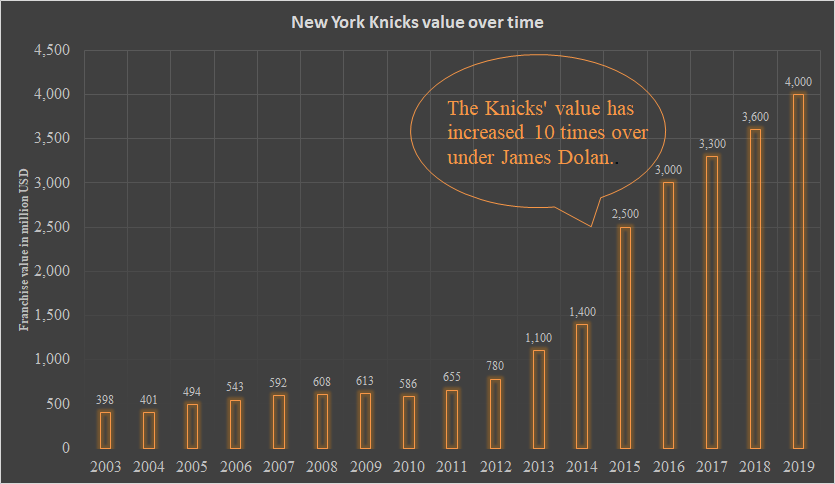
The Knicks lead the league in team value at a whopping $4 billion – despite their dismal performance on the court. The team posted one of the league’s worst records last season and is on track to do the same this season, but it makes sense in the grand scheme of things, say analysts.

“The Knicks have been an unmitigated disaster over the past 18 years, posting only two winning seasons and cycling through 12 coaches,” the report said. “But through it all, owner James Dolan continues to spin straw into gold with the NBA’s most valuable team for the fourth-straight year.”

Data from Christina Gough.

While not the biggest market in the league, that title being held by the Los Angeles Lakers, the Knicks’ market value still trumps the values of 21 teams in the league. Despite being the richest in the league, the Knicks are currently last in the eastern conference.


The reason for this may lie in how that money is spent. According to the team’s data, very little of that $4 billion net worth is spent building a winning team. $611 million is invested in bringing in players, according to Forbes.

Fans know the Knicks’ spending habits well and don’t approve. Harlem resident and lifetime Knick fan Alexander Sandimanie believes the team doesn’t pay that much attention to how the team builds their talent.

“The Knicks have one of the most loyal fan bases in sports history,” Sandimanie said via email. “The team’s free agency attempts have failed them many times. Not to mention the embarrassment Knicks fans experienced over the summer when they missed out on Kevin Durant, Kyrie Irving, and Zion Williamson.”

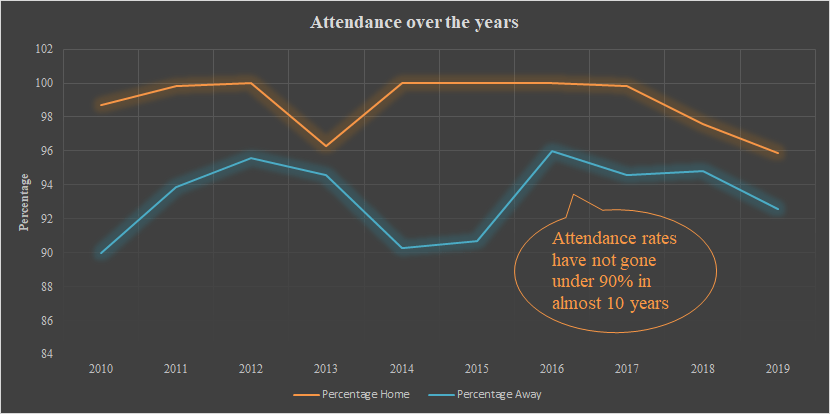
The loyalty from the fans is reflected well in ESPN’s 2019 attendance report. The Knicks had an average of 19,002 fans per home game and 17,566 per away game, placing them ninth out of 30 in the report.

Data from ESPN.com.

Not all fans think the loyalty is deserved though. New Jersey resident and lifetime Knicks fan Mohamed Mahmoud believes the Knicks should show more care and have an open ear when listening to the fans.

“I don’t think the Knicks deserve the backing they get,” Mahmoud said via email. “They know they can change whatever they want, and they’ll still sell tickets.”

Fans aren’t interested in the club as a whole anymore, according to Mahmoud. They care more so about how good a player is. If a player performs, fans will follow.

“It’s going to hurt the Knicks in the long run if they don’t figure something out soon,” Mahmoud said.


A perfect example of spending more than enough but not in a smart manner is the Chicago Bulls. They spend $1.15 billion on the sport, second only to the Boston Celtics at $1.51 billion. Despite this major spending, they’re 11th in the eastern conference, compared to the Celtics at third.

The Milwaukee Bucks offer the best example of spending wisely this season. The team has $889 million invested in the sport. Despite being roughly $250 million behind the Celtics, they lead the eastern conference with a record of 22 wins and three losses, compared to the Celtics 17 wins and six losses.

We could apply the same principle to each professional sports league in the U.S. In the NFL, the highest value team in the league is the Dallas Cowboys, at a total value of $5.5 billion. The last time they won the Super Bowl was in 1996. Meanwhile, the New England Patriots, with a total value of $4.1 billion, have won the Super Bowl three times in the last five years.

In the MLB, the league leader in team value are the New York Yankees, at $4.6 billion. The most recent World Series champion is the Washington Nationals, who are 11th on the list of 30, with a total value of $1.75 billion, a fraction of the Yankees.

The way a team spends their fortune seems to correlate quite well with how they perform. If they spend it smart and know where to invest in, results will follow.

All Music in 2019 Sounds the Same and People are Tuning Out

~Michael Greaney

Music is changing and according to listeners it’s not for the better. A staggering amount of people have been seen tuning out of radio stations and abandoning loyalty to once popular producers over the past few years. Most of these consumers complain of the same problem, that all music today seems to sound the same.  

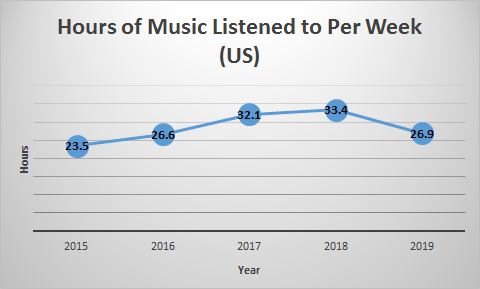
According to the Nielsen Music 2019 Mid-Year report, on demand music streaming and album equivalent consumption are both up from 2018, 31.6% and 15.7% respectively. Shockingly though, average consumer listening hours have decreased from a little over 33 hours a week in 2018 to 26.9 this year.  

Click to access nielsen-us-music-mid-year-report-2019.pdf

Data from Nielsen Music Year end reports 2015-2019

Many researchers and music related media sources have attributed this decline in “viewership” to the homogenization of music over the last decade.  

This slow blend of sound uniformity is blamed by one article published by The Atlantic on what it calls “The Shazam Effect”. This term is what Musicologists now use to describe the rising trend in which music corporations will study popular music to try and determine what sounds will end up high on the charts.  

https://www.theatlantic.com/magazine/archive/2014/12/the-shazam-effect/382237/?single_page=true

As of the middle of 2019, the top five artists, songs and albums have all fallen under the genre of pop, with Ariana Grande sitting comfortably at first in each category. She is followed by artists such as Halsey, Billy Eilish and the Jonas Brothers.  

The Neilsen Music report indicates that one of the most played genres on the radio is pop, partially dominating the airways at a total of 6.9% of all music played as of 2018.  

Click to access us-midyear-music-report-2018.pdf

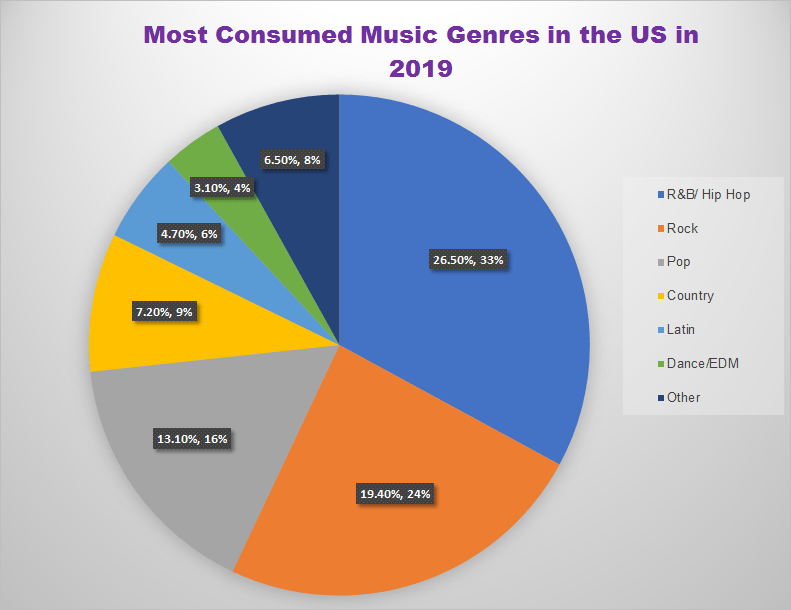
However, while pop is one of the most popular genres played on the radio it is not the most listened-to genre on streaming services. The genres of R&B and Hip hop have a total volume share of 29.6% while Pop only holds a volume share of 13.5%.  

Data collected from Nielsen 2019 year end report

What this shows is that not only does music sound the same to listeners due to The Shazam Effect, but consumers are no longer hearing the genre of music that they want to hear on platforms such as the radio.  

A 2019 Statista survey found that the reasons for users listening to less AM/FM \ radio in North America were an increase in repetitive music, changes in format, the increase in streaming service opinions and a lack of enjoyment or ability to find preferred content. 

https://www.statista.com/statistics/750084/radio-decline-reasons/

One frequent radio listener, Kevin Reda, spoke on his listening experiences; “I tuned into the radio for a long car ride the other day and heard the same song over and over across several radio stations, it’s like they know what’s popular but don’t know what else their listeners want to hear.”  

A poll conducted by CBS shows that music producers have it all wrong. While pop songs are played frequently on various medium, its genres like country and rock that people want to hear.  

The results showed that country music was the preferred genre for 21% of poll respondents and rock came in close second at 18%. They are followed by pop at only 14%, classical at 10%, R&B or soul at 9%, and hip hop or rap at 7%. 

https://www.cbsnews.com/news/cbs-news-asks-what-is-americas-favorite-music-genre/

“I really wish that radio stations would diversify what they played a bit more”, said Marcus Sanchez a frequent concertgoer, “There are so many underappreciated artists that need to be heard.” 

An article by Mic points to a recent study in which researchers from the Medical University of Vienna in Austria studied 15 genres and 374 sub-genres of music. The results showed that as genres become more popular over time, their musical complexity decreases. 

https://www.mic.com/articles/107896/scientists-finally-prove-why-pop-music-all-sounds-the-same

One student, Salvatore Santelli said this about the “sameness” of music today, “Listen, I appreciate pop songs but not when I’m hearing the same ones over and over every day, I’d like to hear more variety in terms of genre when I listen to music anywhere because frankly it’s getting boring.”  

For now, it seems this “boringness” may continue as radio stations continue to play the same few songs on loop daily. However, if producers want to keep their audiences, it may be time to expand their musical horizons.  

Juiced Balls Lead to Controversy

Nick Pinczewski

Professor McMullen

Data Journalism

12/1/19

Juiced Balls Lead to Controversy

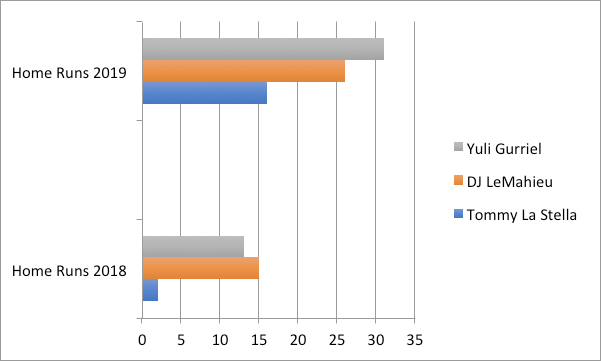
D.J. LeMahieu said he’s always liked hitting home runs. Which means 2019 must have been a very enjoyable season for the Yankees utility man. LeMahieu never hit more than 15 home runs in any of his first eight seasons. He crushed 26 last season.

LeMahieu isn’t the only player to experience a power surge in 2019. In his first five seasons with the Braves and Cubs, Angels second baseman Tommy La Stella hit 10 home runs – combined. Not exactly All Star numbers. But 2019, told a different story. La Stella hit 15 home runs in the first half of the season and was named to the American League All Star Team.

Astros infielder Yuli Gurriel hit 34 home runs in his first three seasons. He blasted 31 last season. Gurriel, has been in the league since 2005 but never hit more than 22 bombs in a season except for 2009. That was 10 years ago, while he was in Cuba!

All across the sport, baseballs left the yard at a record setting pace. Major league hitters obliterated the previous home run record of 6,105 by blasting 6,776 dingers. A staggering 273 players hit 10 or more home runs this season. The Baltimore Orioles pitching staff was shelled for a record 305 home runs.

We can safely say that pitchers didn’t suddenly forgot how to throw strikes. So, what accounted for this season’s remarkable and unprecedented home run surge?

A lot of players, led by Cy Young Award winner Justin Verlander, believe Major League Baseball used “juiced” balls, balls that were easier to hit out of the by relocating the center core, or pill.  According to research done by FiveThirtyEight, changes in the manufacturing of balls came to a climax this season with the production of balls that were easier to hit for longer distances.

“It’s a f—— joke,” Verlander told ESPN. “Major League Baseball’s turning this game into a joke. They own Rawlings, and you’ve got [commissioner Bob] Manfred up here saying it might be the way they center the pill. They own the f—— company. If any other $40 billion company bought out a $400 million company and the product changed dramatically, it’s not a guess as to what happened. We all know what happened.

“Manfred the first time he came in, what’d he say? He said we want more offense. All of a sudden he comes in, the balls are juiced? It’s not coincidence. We’re not idiots.”

MLB bought Rawlings, the sports equipment manufacturing company from Newell Brands for $395 million dollars in June of 2018, according to the Wall Street Journal.

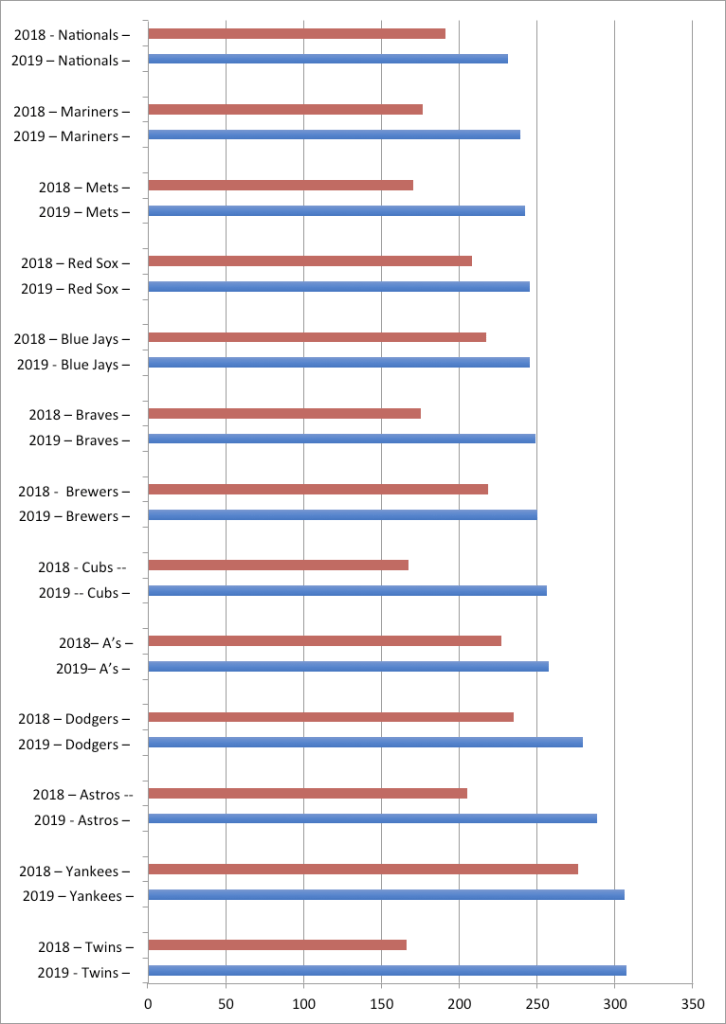
            One year later 24 teams hit 200 plus home runs another MLB Record. Fourteen teams set franchise records. The Twins blasted a league record 307 homers. The Yankeers were second with 306, one year after setting the previous record of 267.

August was a particularly fun month for home run fans as 1,228 home runs were hit. The Yankees had a record 74 of those home runs. The previous record for homers in a month was 58 set in 1999 by the Mariners.

Juicing is not new to baseball but usually the focus is on players, not equipment. In 1997, Mark McGwire and Sammy Sosa electrified baseball fans with a home run battle. It was later found that both players, and many others, were using performance enhancing drugs (PED’s).  It was commonly known as juicing.

MLB implemented one of the most diligent drug-testing programs of any professional sports league. Players are clean. Are the balls?

Manfred denied that the league doctored balls. He offered no explanation for the record 6,776 home runs hit in 2019. In fact, despite the data, he said that MLB doesn’t want an overabundance of home runs.

“The flaw in logic is that baseball wants more home runs,” Manfred told the New York Post. “If you sat in owners meeting and listen to people on how the game is played, that is not a sentiment of owners for whom I work. There’s no desire among ownership to increase homers in the game, to the contrary they are concerned about how many we have.”

Baseball has more home runs than ever. If the numbers increase next season, Manfred will have a hard time saying the balls haven’t been altered.

Sources:


https://www.espn.com/mlb/story/_/id/27731274/inside-long-list-home-run-records-set-2019

https://www.baseball-reference.com/players/l/lemahdj01.shtml

http://theconversation.com/whats-really-behind-baseballs-home-run-surge-120265

https://www.forbes.com/sites/robertkuenster/2019/05/30/are-juiced-balls-the-reason-mlb-is-on-pace-for-another-record-setting-home-run-season/#67c822e53aa1

5 https://nypost.com/2019/08/04/dj-lemahieu-comes-up-clutch-once-again-for-yankees/

6 https://bleacherreport.com/articles/2844856-rob-manfred-denies-mlb-wants-juiced-baseballs-calls-it-a-flaw-in-logic

This is a graph showing the home Run comparison from 2018 to 2019. And the dramatic increase that these three players experienced.

New Rookie Home Run King is Crowned!

Rookie first baseman for the NY Mets, Pete Alonso has gone to places no rookie has ever gone before. Only 6 months ago Mets ownership was debating whether to put Alonso on the Opening Day Roster. Turns out that this move has paid off tremendously as Pete Alonso went on to have one of the best rookie seasons in the history of Major League Baseball.

Pete Alonso was born and raised in Tampa, Florida. He went to high school there where he starred as a third baseman. He then changed to first base when he went off to college at the University of Florida. (The Gators). While there he had the privilege of playing in the College World Series. In 2016, he was drafted in the 2nd round by the New York Mets. After he was drafted he tore it up in the minor leagues particularly in 2018 when he was selected to be part of the Futures Game. The writer of this article was fortunate enough to watch this game and saw just how much potential he had when he hit a towering majestic home run. This gave Mets fans the confidence that Alonso was special and that he could perform when the lights shine brightest. It also inspired confidence in Mets GM Brodie Van Wagenen. According to https://www.espn.com/mlb/story/_/id/26373499/touted-rookie-1b-alonso-mets-roster.

“He showed us, and he certainly showed his teammates, that … he earned it,” Van Wagenen said of Alonso. As for whether the team was tempted to have Alonso start the season in the minors, the GM added: “I do want to focus on winning games. Let’s win as many as we can, as early as we can in the season. And I’m not of the mindset that we should be sacrificing the best product for the fans and the best product for the other 24 guys in that clubhouse to save service time or potential future money six years down the road.”

This bold move paid off in a hurry. Alonso went on to tear up the league right from the get go. There was no transition period. He showed consistency too as we went on to league all of Major League Baseball with a whopping 53 home runs! He also broke the Mets all time single season franchise record! And to top it all off he won the Home Run Derby at the All Star Game. The Mets and their fans embraced him for many reasons and gave him the nickname the (Polar Bear). You never know he could end up succeeding David Wright as the new Mets captain!

https://www.espn.com/mlb/story/_/id/26373499/touted-rookie-1b-alonso-mets-roster

image.jpg