WWE Flourishes Under New Creative Direction

By Brandon Fairweather

Photo taken by WWE

WWE is thriving following allegations that led former CEO and Chairman Vince McMahon to relinquish his duties and retire.  

On June 15th, WWE announced their investigation into the chairman of 40 years after reports of a $3 million settlement with an employee for sexual misconduct. 

McMahon stepped down as the CEO of the company on June 17th and retired on July 22nd. 

On July 25th, Stephanie McMahon, and company executive Nick Khan became the co-CEOs of the company, while Paul “Triple H” Levesque was named the company’s Head of Creative.  

With these changes in company leadership and creative responsibilities, WWE saw a boost in ratings, reviews, ticket sales and approval from the fans and superstars themselves following Vince’s retirement.  

One of the most telling differences in WWE’s new direction is the viewership of their weekly flagship shows Monday Night RAW and Friday Night Smackdown. 
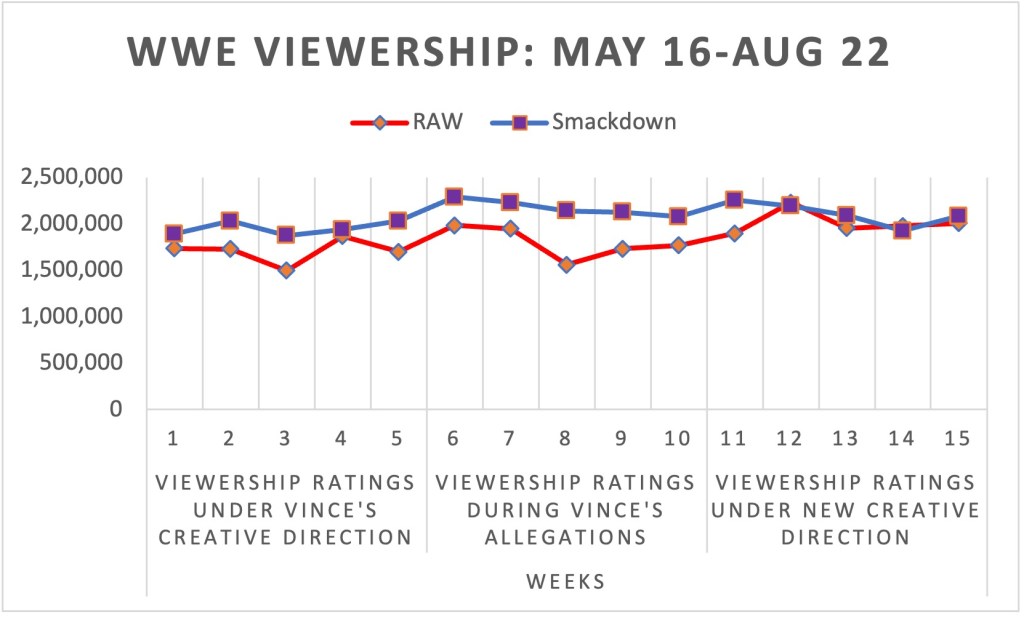
Graphic created using Mohit Raghuwanshi’s RAW and Rohit’s Smackdown WWE viewership database.

In the 5 weeks before Vince’s allegations, an average of 1.7 and 1.95 million people, respectively, tuned into RAW and Smackdown weekly. 45% of the viewers in WWE’s target 18-49 demo tuned into RAW weekly, while 44% would tune into Smackdown. 

Vince’s scandal led to more viewership as during this 5-week period before his retirement, 1.8 and 2.17 million people tuned into RAW and Smackdown weekly, while the company also reached their target demo a lot more as 54% of their viewers aged 18-49 tuned into RAW and 50% tuned into Smackdown. 

Following Vince’s retirement and the onset of a new administration, TV viewership increased and was consistent for both shows. In the 5 weeks following his retirement, 2 million and 2.11 million people tuned into RAW and Smackdown weekly. The company managed to keep their target audience watching with the latest changes still, as 55% of their viewers in the target demo watched RAW and 51% watched Smackdown. 

The ratings for the WWE’s flagship shows RAW and Smackdown also rose and were highest after Vince’s retirement, according to IMDB. 
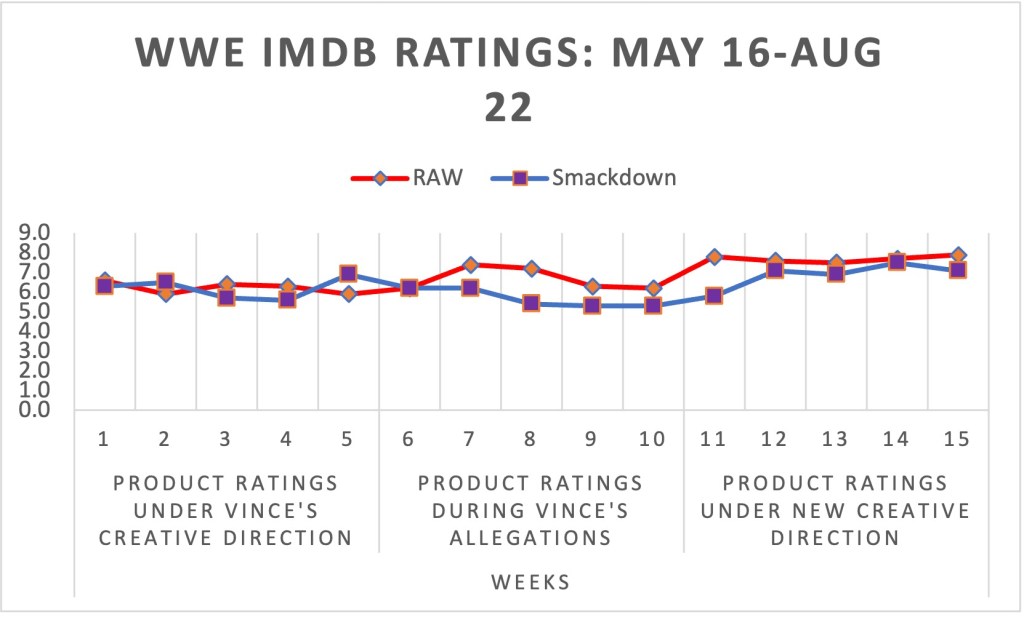
Graphic created using IMDB’s RAW and Smackdown rating database.

During the 5 weeks prior to Vince’s investigation, IMDB gave RAW and Smackdown an average rating of 6.22 and 6.2. Those ratings stood consistent during the 5-week period of Vince’s scandal as both shows were given average ratings of 6.66 and 5.68. The overall ratings of the product went up following Vince’s retirement, as both shows were given an average rating of 7.7 and 6.88. 

Beyond the numbers, these numbers are best put into context by the fans’ admiration of the now Chief Content Officer of WWE, Triple H’s work. 

The company’s also brought back several big names that the fans love, and the company has seen 10 returns of popular stars or tag teams since July 25th.

Triple H has also created a 15% spike in RAW viewership and “increases in social media engagement,” according to WWE

The excitement following WWE at this time has also led to the company’s marquee event, WrestleMania, to selling 90,000 tickets in 24 hours for next year’s outing in Los Angeles, which is 80% percent of its tickets. Triple H also comments on how the company has never sold tickets so quickly, according to the Wrestlezone

In the 3 premium live events since the new administration took over, SportsKeeda, WrestlingHeadlines and WrestlingOps report that SummerSlam, Clash at the Castle and Extreme Rules have all seen vast amounts of success.

Most of the company’s superstars, such as Finn Balor, are also pleased with the changes that have been made, according to the comments he made to CBS

Despite the retirement of wrestling icon Vince McMahon, the WWE has been taken to a new level under the new administration. 
Does the overall value of a team correlate with their performance?

By: Matthew Chaves

The amount of money in sports is greater than ever before, with the four biggest leagues in the U.S., the NFL, MLB, NBA, and NHL respectively, leading the way, according to a report in GlobalSport Matters, which says 106 sports franchises worldwide are worth more than $1 billion each.

Sponsorships, television deals, and fan revenue are some of the major revenue streams in the stock market of sports. Individual teams can earn billions of dollars no matter the sports league.

The NBA is perhaps the best example, with every team recently topping a net worth of more than $1 billion. The lowest of the bunch is the Memphis Grizzlies at $1.2 billion. However, the top of the NBA may be a bit of surprise if you’re to compare it to their performance.


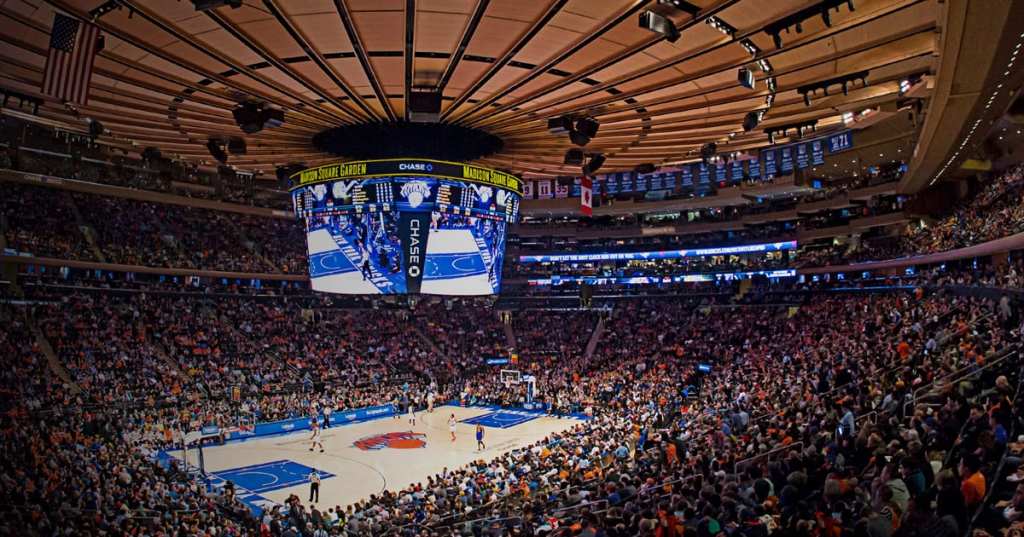
New York is one of the biggest markets for sports in the U.S. And, a report by Forbes that examines the net worth of NBA teams shows why this area of sports in the U.S. is no exception. As reported, the Knicks have a market worth around $1.8 billion, according to the Forbes report. That’s up 11% from a year ago.

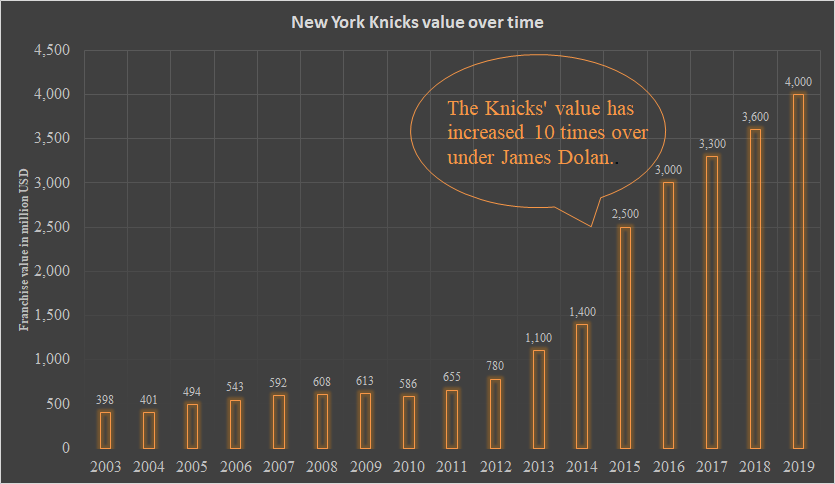
The Knicks lead the league in team value at a whopping $4 billion – despite their dismal performance on the court. The team posted one of the league’s worst records last season and is on track to do the same this season, but it makes sense in the grand scheme of things, say analysts.

“The Knicks have been an unmitigated disaster over the past 18 years, posting only two winning seasons and cycling through 12 coaches,” the report said. “But through it all, owner James Dolan continues to spin straw into gold with the NBA’s most valuable team for the fourth-straight year.”

Data from Christina Gough.

While not the biggest market in the league, that title being held by the Los Angeles Lakers, the Knicks’ market value still trumps the values of 21 teams in the league. Despite being the richest in the league, the Knicks are currently last in the eastern conference.


The reason for this may lie in how that money is spent. According to the team’s data, very little of that $4 billion net worth is spent building a winning team. $611 million is invested in bringing in players, according to Forbes.

Fans know the Knicks’ spending habits well and don’t approve. Harlem resident and lifetime Knick fan Alexander Sandimanie believes the team doesn’t pay that much attention to how the team builds their talent.

“The Knicks have one of the most loyal fan bases in sports history,” Sandimanie said via email. “The team’s free agency attempts have failed them many times. Not to mention the embarrassment Knicks fans experienced over the summer when they missed out on Kevin Durant, Kyrie Irving, and Zion Williamson.”

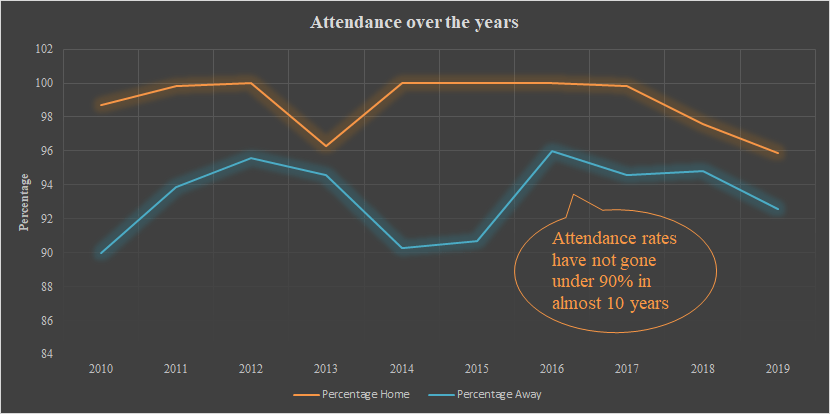
The loyalty from the fans is reflected well in ESPN’s 2019 attendance report. The Knicks had an average of 19,002 fans per home game and 17,566 per away game, placing them ninth out of 30 in the report.

Data from ESPN.com.

Not all fans think the loyalty is deserved though. New Jersey resident and lifetime Knicks fan Mohamed Mahmoud believes the Knicks should show more care and have an open ear when listening to the fans.

“I don’t think the Knicks deserve the backing they get,” Mahmoud said via email. “They know they can change whatever they want, and they’ll still sell tickets.”

Fans aren’t interested in the club as a whole anymore, according to Mahmoud. They care more so about how good a player is. If a player performs, fans will follow.

“It’s going to hurt the Knicks in the long run if they don’t figure something out soon,” Mahmoud said.


A perfect example of spending more than enough but not in a smart manner is the Chicago Bulls. They spend $1.15 billion on the sport, second only to the Boston Celtics at $1.51 billion. Despite this major spending, they’re 11th in the eastern conference, compared to the Celtics at third.

The Milwaukee Bucks offer the best example of spending wisely this season. The team has $889 million invested in the sport. Despite being roughly $250 million behind the Celtics, they lead the eastern conference with a record of 22 wins and three losses, compared to the Celtics 17 wins and six losses.

We could apply the same principle to each professional sports league in the U.S. In the NFL, the highest value team in the league is the Dallas Cowboys, at a total value of $5.5 billion. The last time they won the Super Bowl was in 1996. Meanwhile, the New England Patriots, with a total value of $4.1 billion, have won the Super Bowl three times in the last five years.

In the MLB, the league leader in team value are the New York Yankees, at $4.6 billion. The most recent World Series champion is the Washington Nationals, who are 11th on the list of 30, with a total value of $1.75 billion, a fraction of the Yankees.

The way a team spends their fortune seems to correlate quite well with how they perform. If they spend it smart and know where to invest in, results will follow.

The gradual decline of America’s pastime and it’s new role

By: Matthew Chaves

A baseball fan gets up and gets ready to go to the game in the afternoon. Hyped up, she puts on her jersey, cap, and even has some face paint meticulously put on to show her spirit. She gets in the car with her family and heads towards the stadium. When she gets there, the parking lot has less cars than expected. She gets to her seat, she looks around and notices a lot of empty seats. Throughout the whole experience, that grandiose feeling game day gives gets weaker and weaker, as less people show for the game.

This seems to be the growing trend for MLB fans in recent years. Popularity for baseball was lower than other sports in 2018 and years prior, according to attendance reports from ESPN.com.


Average raw numbers are in favor of the MLB here, though. The average attendance for each team ranges from around 10,000 to 47,000. Those numbers beat out the NBA and NHL’s averages, which range from roughly 12,000 to 21,000. But hockey and basketball are played in arenas, not stadiums.

Compared to a sport that’s played in a stadium, you can see the difference. The lowest average attendance number in the NFL was around 32,000, with the highest being nearly 92,000.

Even the MLS is beating out MLB attendance numbers. Averages go from around 12,000 to around 53,000, showing that even soccer, one of America’s less popular sports, still edges out baseball when it comes to the big leagues.

Television viewership isn’t safe from the decline either. In 2018, the World Series had an average viewership of 14.13 million viewers, according to sportsmediawatch.com. Compared to the 23.4 million viewers in 2016, that’s down roughly 9 million viewers in two years.

Baker Mayfield playing for the University of Oklahoma. Even college football outranks World Series viewership. The College Football Playoff National Championship had a total live viewership of 26,979,000, according to footballfoundation.org. (Photo from flickr.com/brettmadisonelliot)

To be fair, the other big two of football and basketball have also seen declines in the past two years, but have nonetheless amassed more viewers than baseball. In 2018, according to sportsmediawatch.com, the NBA Finals had an average of 15.14 million viewers and the Super Bowl had an average of 98.2 million viewers.

Despite this, the MLB doesn’t see any reason to work on their ratings though when they’re making record profits. According to an article by Forbes, they achieved a record revenue of $10.3 billion in 2018, which doesn’t include their $2.58 billion deal with Disney.


The revenue doesn’t reflect real success when it comes to popularity though, according to Washington Nationals player Sean Doolittle. He tweets about the article aforementioned but goes into the reasons why he thinks attendance is down throughout the league.

New York Times writer Juliette Love talks about it best in her article about the declining attendance and viewership ratings. Love crunches through the figures to come the conclusion that baseball isn’t dying but instead is making a transition. The fans care about their team and how well they do, and, as Doolittle says, if most teams are going through rebuild seasons, fans aren’t going to go watch. They want to see their teams try to win.

Serena Williams Reaches for the Top

New York Times September 7, 2019

Serena Williams will face Bianca Andreescu of Canada in the United States Open final on Saturday in a quest to notch her 24th Grand Slam singles title, which would equal the mark of Margaret Court, above, who has held sole possession of the women’s record for decades.

The women at the top of the list of Grand Slam titles span many eras of tennis history, starting from a time when these championships were not considered the absolute currency that they are now when discussing the greatest players ever.

Is A 40-Homer Season A Big Deal Anymore?

From 538 August 2019

According to data from Baseball-Reference.com, Alonso’s blast in Kansas City marked the first time that four hitters have reached 40 or more homers through their teams’ 125th game played since 2001, when it was accomplished by Barry Bonds, Sammy Sosa, Luis Gonzalez and Jim Thome. It was just the third time in Major League Baseball history,1 with 1998 marking the other occasion (Sosa, Mark McGwire, Ken Griffey Jr, Greg Vaughn). Bonds hit 54 home runs through 125 games in 2001, the most in history.

The baseball world hasn’t witnessed a home run race like this since the height of the steroid era.

When Mets star Pete Alonso set the National League rookie home run record on Sunday, he joined Mike Trout, Christian Yelich and Cody Bellinger in this season’s 40-homer club … in the middle of August.

Total home runs are on pace to shatter the MLB record this season, and three of the top four seasons by total home runs have come in the past four years. But until this year, individual season totals had fallen short of those of the steroid era. Though Giancarlo Stanton made it to 59 homers in 2017, the last hitters to reach 60 were Bonds and Sosa in 2001. Perhaps after 20-plus years of wondering what to do with homers of the late 1990s and early 2000s, this generation will have to wrestle how to place today’s homer binge, thought to be fueled by livelier balls and higher launch angles, in context.