By Maggie Dougherty
Chris Murphy’s passion for gun control had not always been a large part of his political career. It wasn’t until the Sandy Hook school shooting in 2012 that the Democratic senator from Connecticut took it upon himself to work on the issue. Since then, he has become a leading voice in the Senate in the fight for stricter gun laws.
On the day of the mass shooting at Robb Elementary in Uvalde, Texas on May 24, Murphy ended up on the Senate floor just moments after the massacre. He presented a plea to the other senators, saying, “I’m here on this floor to beg, to literally get down on my hands and knees and beg my colleagues. Find a path forward here. Work with us to find a way to pass laws that make this less likely. I understand my Republican colleagues will not agree to everything that I may support, but there is a common denominator that we can find.”

Shuran Huang for The New York Times
Murphy’s speech that day echoed the desperation that many Americans feel when thinking about the topic of preventing gun violence, due to the stark partisan divide on the issue. However, he also expressed hope that there could be bipartisan common ground. Data reflects these sentiments.
According to a Pew Research Center national survey conducted from April 5-11, 2021 among 5,109 adults, about half of Americans want stricter gun laws (53%). This marks a seven point decline from Sept. 2019, when 60% of Americans wanted stricter gun laws. Almost a third of adults believe that gun laws are about right (32%) and 14% say that the laws should be less strict.
Opinions about gun violence vary widely based on political party affiliation. For Republicans and Republican-leaning independents, approximately half say that current gun laws are about right while only 20% are in favor of stricter laws. Another 27% believe that gun laws should be less strict. On the other hand, a large majority (81%) of Democrats and Democrat-leaning independents want stricter gun laws.
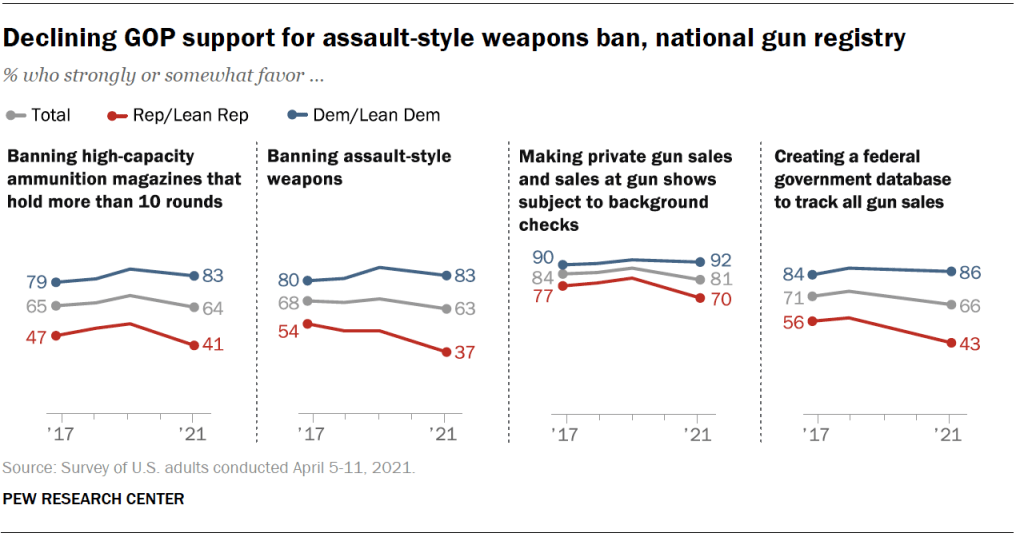
These partisan rifts apply to specific policy proposals as well. Whereas 86% of Democrats support creating a federal database to track all firearm sales, only 43% of Republicans agree. Similarly, while 83% of Democrats want to ban assault-style weapons, this number has dropped down to 37% for Republicans. GOP support for both of these proposals has declined in recent years.
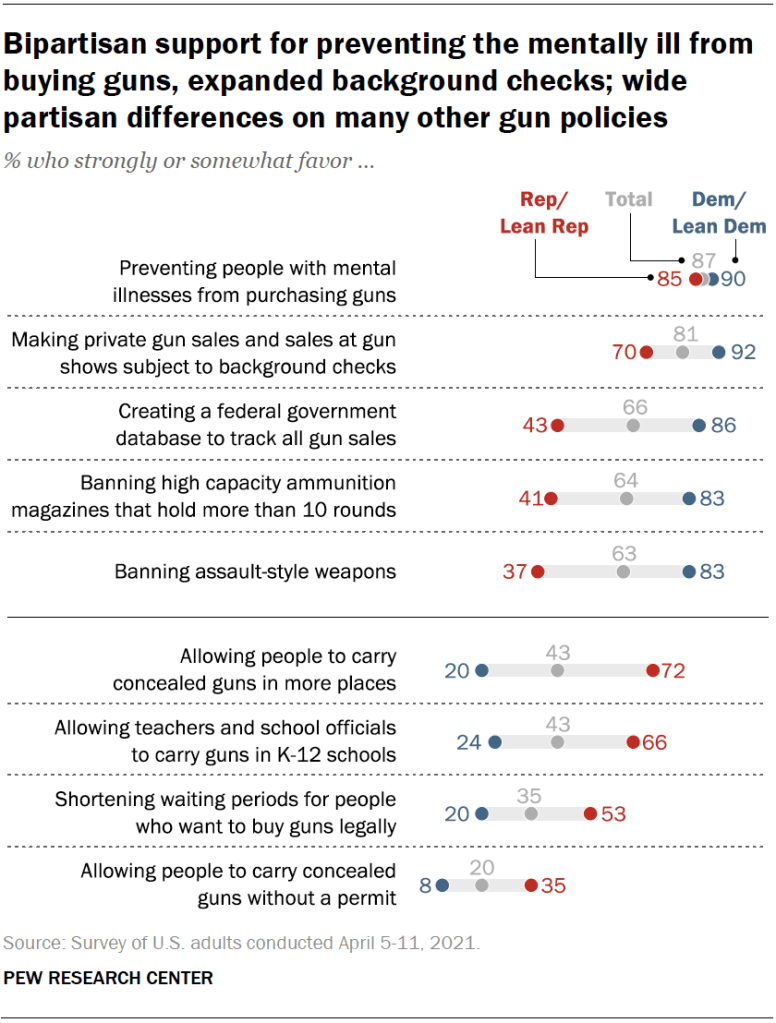
However, despite these partisan divides, some gun policy proposals have broad bipartisan support. 90% of Democrats and 85% of Republicans agree that people with mental illnesses should be prevented from buying guns. A majority of Democrats (92%) and Republicans (70%) support having background checks for both private gun sales and gun show sales. Majorities in both parties also oppose letting people carry concealed guns without a permit.
“The question is, well, ‘Why are a lot of these [policies] not in place?’…When you look at voter sentiments, a lot of these seem like pretty common sense, no-brainer items,” said Mike Noble, the chief research and managing partner of the market research company OH Predictive Insights.
The answer to this question largely lies in the gun rights lobby. The National Rifle Association (NRA) has given rise to a gun culture in America that has turned gun ownership into a political identity. Matthew Lacombe, a professor of political science at Columbia University’s Barnard College, explains how this dynamic has played out.
“Although most Americans have historically favored gun control regulations, the minority of Americans who oppose them have historically mobilized on behalf of that view at higher rates than gun control supporters,” Lacombe said in an interview with Vox.
A month after Chris Murphy gave his impassioned speech on the Senate floor, the senator led the charge for the Bipartisan Safer Communities Act to pass through Congress. This legislation ended the nearly 30 years of congressional inaction on gun violence by enhancing background checks for potential buyers under 21, implementing red flag laws that allow officials to temporarily confiscate guns from people deemed too dangerous to own them, and funding for mental health programs and school security. Furthermore, the bill closes the boyfriend loophole, tightening a federal ban on domestic abusers buying firearms.
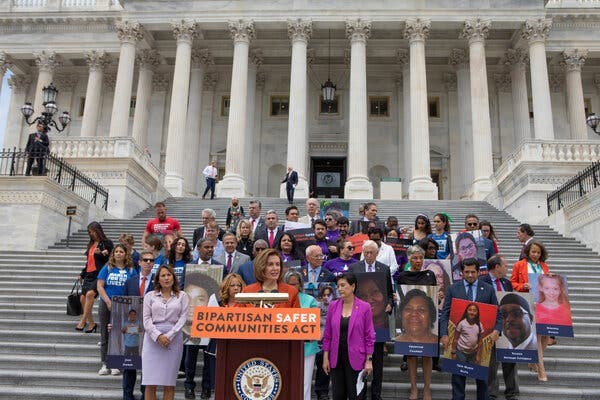
Anna Rose Layden for The New York Times
Murphy celebrated the victory and acknowledged the work that still needs to be done.
“Our bill is a compromise that doesn’t do everything I want, but it will save thousands and thousands of lives. It’s just the beginning of what this movement can and will accomplish, and I’ll never stop fighting to get us there,” Murphy said.

 Data Journalism 395